Your signature is a small piece of handwriting that can become instantly recognizable.
It might appear at the end of a handwritten letter, on a greeting card, beneath a piece of artwork, or on an important document. And although you may write it in just a second or two, its appearance can feel surprisingly personal.
Maybe your current signature looks like a hurried scribble. Perhaps you've always written your name in ordinary print and want something more elegant. Or maybe you're looking for a beautiful cursive signature with a distinctive capital letter and a simple flourish.
Whatever your starting point, learning how to create a beautiful signature doesn't require professional calligraphy skills.
The key is to find a design that suits your name, feels comfortable in your hand, and is easy to reproduce.
In this guide, you'll discover 25 signature ideas, from minimal initials and classic cursive to elegant underlines and creative flourishes. You'll also learn how to design your own signature step by step, practice difficult movements, avoid common mistakes, and explore digital signature-style options.
How to Create a Beautiful Signature in 7 Easy Steps
To create a beautiful handwritten signature, start with your name and gradually simplify or stylize its letterforms until you find a comfortable, recognizable design.
Here's a practical method:
- Write your name normally. Start with your first name, surname, or full name.
- Choose a signature structure. Decide whether to use your full name, initials, or a combination.
- Highlight one distinctive feature. This might be your first capital, a tall letter, or an elegant finishing stroke.
- Connect or simplify the letters. Use comfortable cursive movements rather than drawing every letter separately.
- Experiment with slant and spacing. Find proportions that look balanced.
- Add one optional flourish. Try a modest underline, a small terminal curve, or a distinctive capital.
- Practice at your natural signing speed. Keep refining until the design is reasonably consistent and easy to repeat.
For example, someone named Sophia Miller might experiment with three structures:
- Sophia Miller — full name in flowing cursive.
- S. Miller — first initial followed by surname.
- SM — initials as a compact decorative mark.
These are design starting points, not rules for how your legal signature must appear.
The most useful test: Can you write your chosen signature comfortably several times without carefully redrawing every stroke?
If the answer is no, simplify the design.
What Makes a Signature Beautiful?
A beautiful signature isn't necessarily the most complicated one.
In fact, a few well-controlled features can make a signature look more polished than multiple oversized loops or flourishes.
1. Balanced proportions
A large opening capital can look elegant, but it shouldn't overwhelm every other letter.
Try making the capital slightly more prominent than the remaining characters.
2. Smooth writing rhythm
Signatures often look natural when the strokes flow comfortably.
The motion should feel like writing rather than tracing a decorative image.
3. A recognizable structure
Your signature doesn't need to be perfectly readable, but it should have a consistent overall form.
That might mean a recognizable initial, a familiar surname outline, or a repeatable finishing stroke.
4. Consistent slant
A gentle forward slant can create a flowing appearance.
An upright signature can be equally attractive if the letter shapes work together.
5. Controlled decoration
A small underline or terminal flourish can create personality.
Too many decorative strokes may make the signature slower, harder to reproduce, and less suitable for everyday use.
6. Comfortable movement
A design that strains your hand or requires constant corrections probably isn't ideal for frequent signing.
Choose movements that feel natural with an ordinary pen.
25 Beautiful Signature Ideas to Try
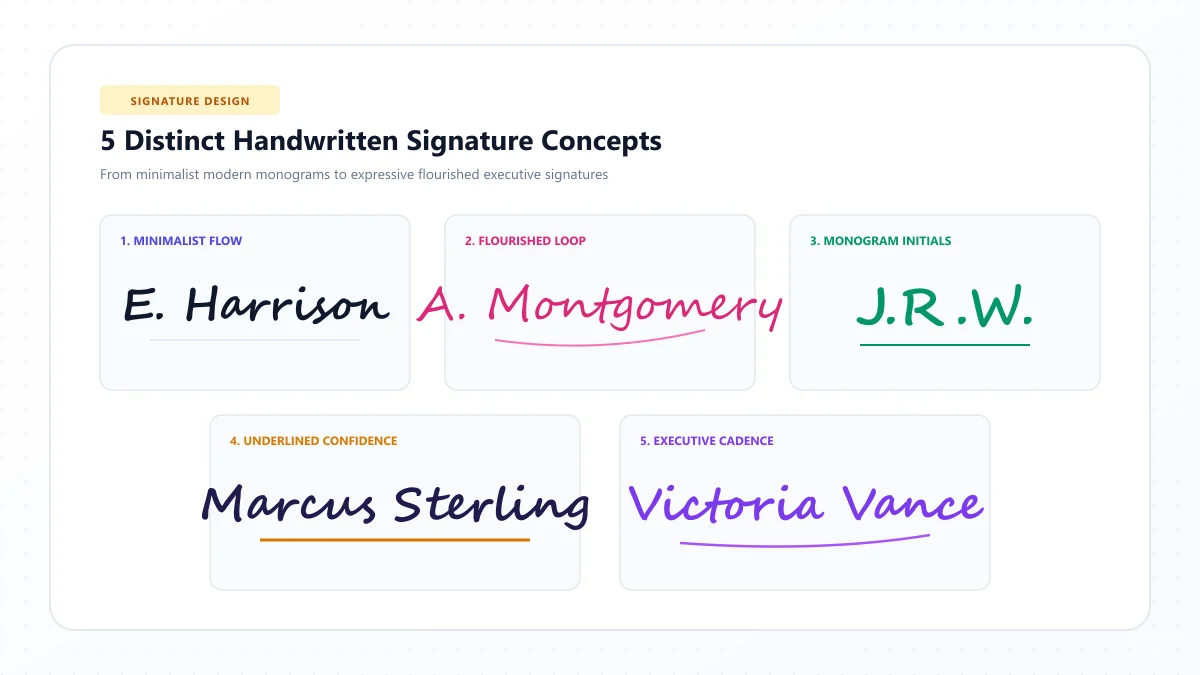
The following 25 ideas are organized into five groups.
Each design has a distinct structure you can adapt to your own name.
Category | Ideas | Best for |
|---|---|---|
Simple and minimalist | 1–5 | Everyday signing |
Elegant cursive | 6–10 | Traditional handwritten style |
Initial-based | 11–15 | Compact personal marks |
Creative and decorative | 16–20 | Cards, artwork, personal branding |
Professional and practical | 21–25 | Frequent, consistent signing |
These are design instructions rather than exact visual reproductions. Use pen-and-paper samples to discover how they work with your particular letters.
Simple and Minimalist Signature Ideas (1–5)
Simple signatures focus on clean forms, efficient movements, and a balanced overall shape.
They're especially useful if you prefer understated handwriting.
1. The Clean Full-Name Signature
Write your complete first and last name in a consistent, slightly slanted cursive style.
Keep the capital letters recognizable and the lowercase letters compact.
Try it with: Sophia Miller
How to practice: Write the two names separately, then combine them with an even space.
Best for: People who prefer a formal, readable appearance.
2. The First-Name-Only Signature
Use your first name as the main visual element.
Make the first capital slightly taller, then let the remaining letters flow naturally.
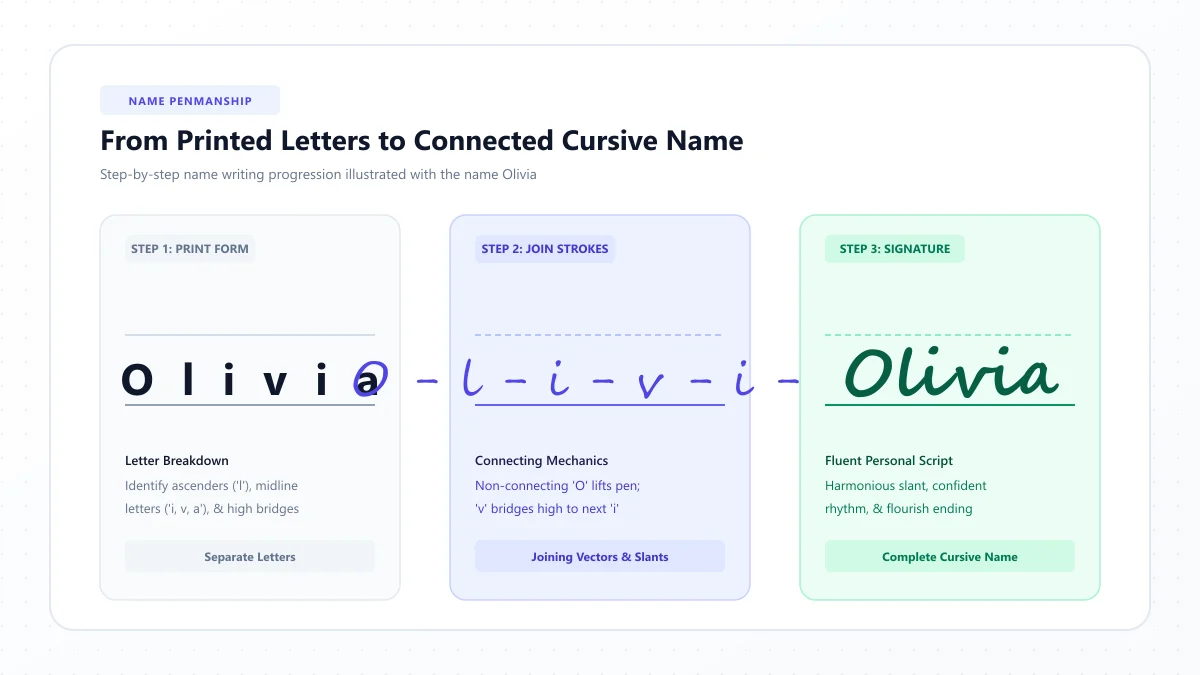
Try it with: Olivia
How to practice: Repeat the first name until the capital and finishing stroke feel balanced.
Best for: Artwork, friendly notes, informal cards, or a personal creative mark.
For official documents, follow any applicable signing requirements rather than assuming a first-name-only design will suit every situation.
3. The Minimal Surname Signature
Use your surname as the main design.
Start with a recognizable capital, then write the remaining letters in a smaller, consistent style.
Try it with: Wilson
How to practice: Experiment with two capital sizes and choose the one that looks more balanced.
Best for: Understated personal branding and everyday signature inspiration.
4. The Gentle Slant Signature
Keep the letterforms simple but add a consistent forward slant.
The result can look more fluid without needing additional loops.
Try it with: Daniel Harris
How to practice: Use ruled paper and lightly mark a slant guideline while learning.
Best for: People who like a clean, traditional cursive appearance.
5. The Compact Signature
Reduce unnecessary spacing and use a shorter horizontal shape.
Avoid squeezing letters so tightly that your pen movements become uncomfortable.
Try it with: Elizabeth Brown
How to practice: Write the full signature inside a small rectangular space, then simplify the widest strokes.
Best for: Signing forms or working in limited spaces.
Elegant Cursive Signature Ideas (6–10)
Elegant cursive signatures emphasize letter connections, controlled curves, and a natural writing rhythm.
They can be beautiful without becoming ornate.
6. The Classic Flowing Cursive Signature
Write your name using a consistent joined cursive handwriting model.
Use proportionate capitals and connected lowercase letters where appropriate.
Try it with: Amelia Grace
How to practice: Focus on the entry and exit strokes between lowercase letters.
Best for: Traditional handwritten notes and graceful everyday signing.
7. The Oversized First Capital
Make the first capital larger and more expressive than the rest of the name.
Keep the remaining letters relatively simple to create contrast.
Try it with: Charlotte Evans
How to practice: Draw several variations of the opening C, then write the remaining letters at normal speed.
Best for: Names with distinctive initial shapes.
8. The Loop-Accent Signature
Choose one natural loop in your name and make it slightly more prominent.
For example, you might emphasize the loop in a lowercase l or h.
Try it with: Lily Harper
How to practice: Keep all other loops restrained so the featured loop stands out.
Best for: Soft, elegant signature designs.
9. The Smooth Ending Stroke
Use a clean terminal stroke that follows naturally from the final letter.
It can end in a slight upward curve or a short, tapered line.
Try it with: Emma Rose
How to practice: Write the final two letters repeatedly until the ending movement becomes comfortable.
Best for: Names that end in letters with useful exit strokes.
10. The Light Calligraphy-Inspired Signature
Use refined proportions and a controlled slant inspired by traditional penmanship.
Keep the letterforms simple enough to repeat with a regular pen.
Try it with: Isabella Morgan
How to practice: Begin with consistent lowercase forms, then experiment with a more expressive capital.
Best for: Elegant letters, personal stationery, and creative writing.
You don't need a pointed calligraphy pen to explore the overall shape. Specialized tools become relevant if you want actual shaded calligraphic strokes.
Signature Ideas Using Initials (11–15)
Initial-based signatures can be compact and distinctive.
They also let you emphasize a surname or create a simple personal mark.
11. First Initial + Full Surname
Write the first initial prominently, followed by your surname.
Example structure: S. Miller
How to practice: Make the initial clear and allow the surname to flow naturally.
Best for: A practical, recognizable signature style.
12. Two Connected Initials
Combine your first-name and surname initials with a shared movement.
Example structure: SM
How to practice: Draw several ways to join the two capitals without making either one unrecognizable.
Best for: Personal monograms, artwork, and compact decorative marks.
Whether initials alone are suitable for a particular formal document depends on the context and signing requirements.
13. Large Initial + Small Name
Use one large capital followed by a small, compact version of the rest of your name.
Try it with: Alexander
How to practice: Experiment with a tall A and a narrower lowercase sequence.
Best for: A bold yet restrained signature design.
14. Initials With a Simple Underline
Write your initials clearly and place a short line beneath them.
The underline can begin as an extension of the final stroke.
Example structure: A.M. with a short underline
How to practice: Keep the underline shorter than the width of the initials.
Best for: Decorative monograms and personal marks.
15. Interlocking Initials
Overlap or interweave two capital letters in a visually balanced way.
For example, a tall L could share space with the curve of a C.
How to practice: Sketch the two letters separately, then look for a point where their forms naturally meet.
Best for: Logos, stationery, personal branding, and artwork.
This is usually better treated as a monogram design than as a replacement for a regularly used formal signature.
Creative and Decorative Signature Ideas (16–20)
These styles add more visual personality.
Use them selectively, especially if the signature will appear in creative work rather than on routine paperwork.
16. The Single Underline Signature
Write your name in cursive and extend the final stroke beneath it.
Try it with: James Oliver
How to practice: Begin the underline from the final letter if its exit allows a natural movement.
Best for: A classic signature look with one clear accent.
17. The Double-Line Accent
Use two short, parallel strokes beneath a simple name.
Keep the lines thin and subordinate to the lettering.
Try it with: Mia Stone
How to practice: First perfect the name, then add the lines without changing the basic structure.
Best for: Decorative graphics, personal stationery, and creative signatures.
For a formal everyday signature, one fewer decorative stroke may be easier to reproduce.
18. The Final-Letter Flourish
Turn the natural exit of the last letter into a gentle curve.
Avoid wrapping the flourish around the entire name unless you can reproduce it comfortably.
Try it with: Olivia Rose
How to practice: Work only on the last three letters and their ending stroke.
Best for: Elegant cards and personal lettering.
19. The Long Capital Sweep
Begin the first capital with a slightly extended entry stroke.
This can create a graceful opening without altering the whole name.
Try it with: Grace Martin
How to practice: Compare several versions of the capital G, keeping the remainder of the name unchanged.
Best for: Names with capitals that naturally support a sweeping movement.
20. The Artistic Signature Mark
Combine a readable name or initials with one distinctive visual detail.
This might be a small curve, geometric accent, or simplified personal symbol.
Try it with: Your own initials
How to practice: Keep the lettering and symbol consistent in size and placement.
Best for: Illustrators, photographers, designers, and other creative uses.
Avoid using a complicated symbol in situations where a repeatable handwritten signature is required.
Professional and Practical Signature Ideas (21–25)
A professional-looking signature generally benefits from clarity, restraint, and consistency.
These designs prioritize ease of use.
21. The Traditional First-and-Last Signature
Use a recognizable first name and surname in simple cursive.
Avoid added hearts, stars, or elaborate decoration.
Try it with: Daniel Cooper
How to practice: Aim for similar proportions each time rather than perfect duplication.
Best for: Everyday professional correspondence and routine signing.
22. The Initial-and-Surname Classic
Use one distinct capital initial followed by a compact surname.
Example structure: D. Cooper
How to practice: Keep the initial prominent while maintaining a consistent surname outline.
Best for: Someone with a long first name who wants a shorter design.
23. The Legible Signature
Preserve enough of the letterforms for the name to be read without considerable effort.
Use simple joins and minimal flourishes.
Try it with: Sarah Lewis
How to practice: Ask someone to read the name from an ordinary writing sample.
Best for: Professional letters and situations where readability is helpful.
24. The Fast Everyday Signature
Simplify the strokes that slow you down while keeping the overall design recognizable.
Avoid drawing decorative loops carefully every time.
Try it with: Your usual signing name
How to practice: Sign at a comfortable everyday pace and identify which movements consistently cause hesitation.
Best for: People who sign frequently.
The aim isn't speed at the expense of control. A consistent, comfortable movement matters more.
25. The Balanced Signature With One Flourish
Combine a readable name, a noticeable capital, and one finishing accent.
This is a versatile compromise between elegance and practicality.
Try it with: Emily Parker
How to practice: Repeat the complete signature several times, then remove whichever decorative stroke feels least natural.
Best for: A polished personal signature that remains manageable for regular use.
Which Signature Style Is Best for Your Name?
The most suitable design depends partly on the length and structure of your name.
Name type | Signature approach to try |
|---|---|
Short first name | First-name cursive with expressive capital |
Long first name | First initial with full surname |
Short surname | Full name with balanced spacing |
Long surname | Compact surname or an initial-based structure |
Double-barreled surname | Consistent capitals and clear punctuation |
Name with tall letters | One restrained loop accent |
Name ending in y or g | Controlled ending stroke |
Name with distinctive capitals | Emphasize the first initial |
Creative personal mark | Interlocking initials or monogram |
Frequently used signature | Compact, repeatable handwriting |
These suggestions concern appearance and convenience, not legal eligibility. The wording or mark accepted for a formal signing purpose depends on its requirements.
How to Design Your Own Signature Step by Step
Now that you've explored the ideas, let's build a personal design.
We'll use Sophia Miller as an example.
Step 1: Choose what to include
Write three alternatives:
Sophia Miller
S. Miller
SM
Look at which one best fits your purpose.
A full name may feel traditional, while an initial-plus-surname structure may be faster to write.
Step 2: Identify the most distinctive letter
For Sophia Miller, the capital S and M offer obvious starting points.
Try writing each capital in two or three different styles.
Keep the movements natural.
Step 3: Decide on the letter connections
If you've chosen a cursive full-name design, examine how the lowercase letters join.
For example, the o-to-p connection may feel different from the h-to-i movement.
Practice only the difficult pairs.
Step 4: Adjust the slant
Write the chosen name upright.
Then write it with a gentle forward slant.
Compare the versions and choose the one that feels comfortable.
Step 5: Add one accent
Try a slightly extended capital stroke or a short underline.
Avoid adding several decorative elements at once.
Step 6: Test different sizes
Write the signature once at a comfortable size and once in a smaller signing space.
If it becomes unreadable or awkward, simplify the loops and extended strokes.
Step 7: Repeat at your normal pace
Write the finished design several times without looking at the previous attempt.
The copies won't be identical, and that's normal for handwriting.
Look for a similar beginning, letter rhythm, overall width, and ending.
Step 8: Keep refining
Compare the results and identify what feels least natural.
Usually, removing an unnecessary movement is more useful than adding another flourish.
How to Make Your Signature Look Elegant Without Being Complicated
You can improve the appearance of almost any signature with a few practical adjustments.
Make the opening capital the focal point
A distinctive first letter often gives a signature enough personality on its own.
Keep the lowercase forms smaller
This creates a natural visual hierarchy between the capital and the rest of the name.
Use a consistent baseline
If the name rises and falls unpredictably, practice on ruled paper.
Avoid unnecessary pen lifts
A smoother movement can improve rhythm.
However, don't force connections that don't suit your chosen letterforms.
Control your finishing stroke
One intentional exit stroke usually looks more polished than several accidental marks.
Prioritize your natural hand movement
Your signature should work with your handwriting tendencies.
It doesn't need to resemble a font or historical calligraphy exemplar.
How to Create a Signature With Initials
Initials are useful when you want a compact, recognizable mark or a decorative monogram.
Start by writing your initials separately.
For example:
S M
Then test three approaches.
Separate initials: Write each capital independently with balanced spacing.
Connected initials: Use a shared stroke to create a flowing relationship.
Overlapping initials: Combine the two shapes into a monogram-like design.
Choose the approach that makes the initials recognizable and comfortable to reproduce.
Remember that a decorative monogram and a signature used to authorize a document serve different purposes. Don't assume a stylized initials logo will meet the requirements of every formal transaction.
How to Create a Beautiful Signature With a Long Name
Long names require special attention to spacing and overall width.
Consider a name such as Anastasia.
Writing every letter in elaborate calligraphy could make the signature extremely wide and slow.
Instead, experiment with a practical structure.
You might try:
- The full name in compact cursive.
- First initial followed by the full surname.
- A more prominent surname with a smaller first name.
- A simple first-and-last combination without flourishes.
Preserve correct punctuation and spelling where required.
For a hyphenated surname, consider keeping the punctuation clear rather than hiding it in a decorative stroke.
How to Practice Your Signature Every Day
Once you've chosen a design, regular practice can help the movements feel more familiar.
Try this five-minute routine.
Time | Exercise |
|---|---|
Minute 1 | Practice the opening capital |
Minute 2 | Practice the lowercase sequence or surname |
Minute 3 | Repeat the final stroke or underline |
Minute 4 | Write the complete signature several times |
Minute 5 | Compare results and adjust one feature |
Use an ordinary pen and comfortable writing position.
After a few sessions, test the signature in different circumstances.
Write it on lined paper, blank paper, and inside a small rectangular space.
You can also try writing it without warming up first.
A practical design should remain recognizable even when you haven't spent several minutes preparing.
The Signature Repeatability Test
Before settling on a design, try this quick test.
Write your signature five times at a natural pace.
Then review the results using the following questions.
Question | What to look for |
|---|---|
Is the first capital recognizable? | Similar overall form |
Is the signature comfortable? | No forced or painful movement |
Is the width reasonably consistent? | No extreme variation |
Does the ending stroke repeat naturally? | Similar direction and length |
Can you sign in a small space? | No major loss of structure |
Can you write it without a reference? | Movements feel familiar |
The goal is not five mechanically identical copies.
Natural signatures vary. Look for a repeatable overall pattern.
If the signature is difficult to reproduce, remove some decoration and test again.
Common Signature Design Mistakes
Making it too complicated
A beautiful design on a practice sheet may be difficult to repeat on a busy day.
Fix: Reduce the number of decorative movements.
Using an oversized underline
A long underline can overwhelm a short name.
Fix: Keep the underline proportional to the lettering.
Copying someone else's signature exactly
Another person's letterforms may not suit your name or natural hand movement.
Fix: Use general design ideas for inspiration and create a mark that is genuinely yours.
Changing the structure every time
Normal variation is expected, but repeatedly changing the entire design can reduce consistency.
Fix: Choose a practical structure and practice it until it feels natural.
Ignoring letter spacing
Crowded lowercase forms can become a dense scribble.
Fix: Practice the name slowly and identify which connections need more room.
Trying to reproduce a font perfectly
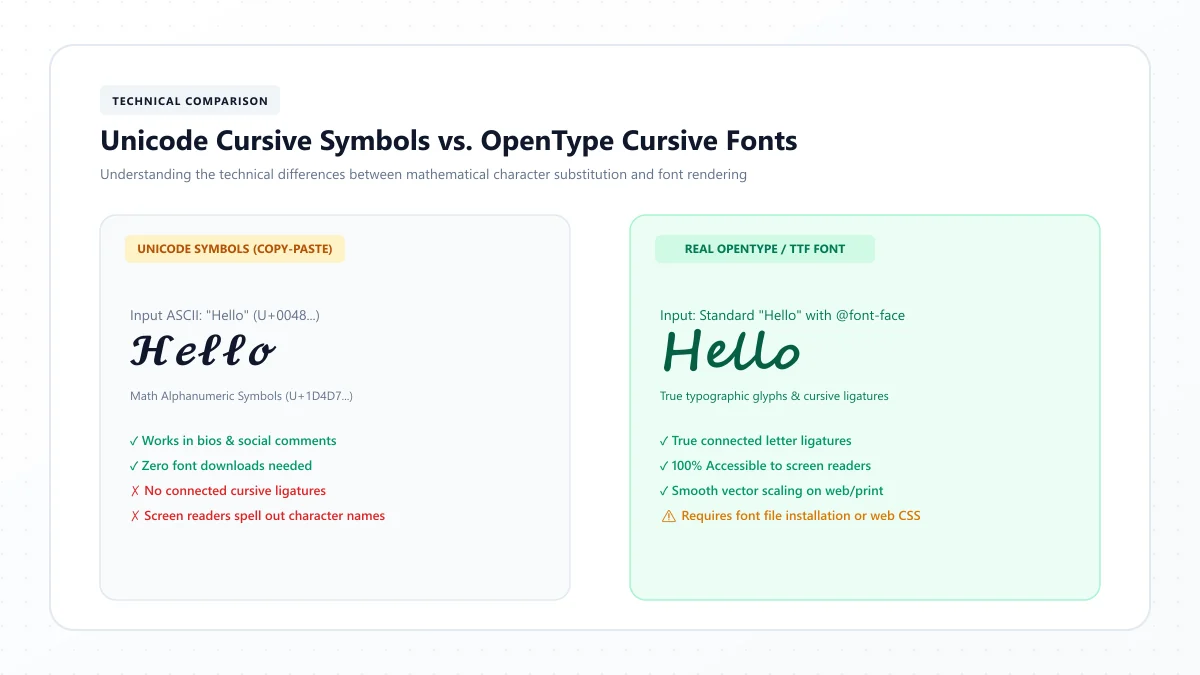
A digital script preview can inspire your design, but fonts don't necessarily demonstrate natural pen movement.
Fix: Adapt the shapes to your own handwriting.
Using decorative marks in every context
A star or heart might suit artwork or a greeting card but may be inappropriate for certain formal documents.
Fix: Consider the purpose before choosing a design.
How to Create a Beautiful Signature Online
An online signature generator can help you explore different visual styles before practicing a design on paper.
Our Cursive Signature Generator lets you type your name and customize its signature-style appearance.
Depending on your preferences, you can explore:
- Different ink colors.
- Signature slant.
- Letter size.
- Stroke weight and visual appearance.
- A transparent PNG export.
For example, enter:
Sophia Miller
Experiment with a more upright version, then a slanted one.
Compare the proportions, capital letters, and overall shape.
Use the result as a design reference, not as a substitute for learning the physical pen movements.
For additional typographic inspiration, try our Signature Font Generator.
Can you use a generated signature PNG on documents?
A transparent PNG is a visual asset that can be inserted into a document or graphic.
Whether it is suitable for an actual signing transaction depends on the relevant document, applicable law, the signer's intent, and the process used to adopt or authenticate the signature.
Simply placing an image on a document doesn't automatically establish who signed it or whether the necessary requirements were met.
For contracts or regulated documents, use the signing method required by the receiving organization or relevant workflow.
Handwritten Signatures vs. Electronic Signatures vs. Digital Signatures
These terms are related but have important differences.
Handwritten signature
A handwritten signature is a mark made by a person, usually with a pen on paper, to identify or express approval in a particular context.
Its appearance may be clear cursive, initials, or another personal mark, depending on applicable requirements.
Electronic signature
In the United States, an electronic signature can include an electronic sound, symbol, or process associated with a record and adopted with the intent to sign.
It isn't limited to a picture of a handwritten signature.
The legal effect of an electronic signature depends on the applicable legal framework and transaction requirements.
Digital signature
In technical usage, a digital signature generally refers to a cryptographic method for authenticating digital data and detecting changes.
It is not the same thing as a decorative signature image.
Type | What it is | Main consideration |
|---|---|---|
Handwritten signature | Physical personal mark | Identity, intent, and context |
Electronic signature | Electronic action, symbol, or process used to sign | Applicable law, intent, and process |
Cryptographic digital signature | Technical authentication mechanism | Cryptographic verification |
Signature-style PNG | Visual image of lettering | Not proof of identity by itself |
A typed or graphical mark is not automatically invalid merely because it is electronic, but it also doesn't automatically satisfy every signing requirement.
If a document requires identity verification, records of consent, or a designated signing platform, use that approved process.
Beautiful Signature Ideas for Different Purposes
The right design also depends on where the signature will appear.
For everyday documents
Choose a compact and repeatable style.
Avoid oversized flourishes that require a large signing area.
For personal stationery
A flowing cursive name with a gentle finishing stroke can look elegant.
For artists and creators
A short first-name signature or monogram may work as a recognizable mark on original artwork.
For authors
A slightly expressive handwritten name can suit personal notes and book signings.
For photography watermarks
A signature-style graphic can be used as a visual brand element.
Remember that a watermark is not the same as a legally authenticated signature.
For greeting cards
You can be more playful with loops, underline styles, and decorative initials.
Use the context to decide how elaborate the result should be.
Frequently Asked Questions About Beautiful Signatures
How do I create a beautiful signature for my name?
Start with your first name, surname, or initials. Choose a readable structure, emphasize one distinctive letter, add a comfortable slant, and practice the design until you can reproduce it naturally.
What is the easiest signature style?
A simple first initial followed by a surname, or a compact cursive full name, may be easier to repeat than a highly decorated design. The best choice depends on your handwriting.
How can I make my signature look professional?
Keep the design consistent, proportional, and relatively simple. Use one recognizable capital or a restrained finishing stroke instead of several elaborate decorations.
Should my signature be readable?
Not necessarily in every context, but a recognizable and repeatable structure is useful. Some purposes may impose specific signing or identification requirements.
Can I use just my initials as a signature?
Initials may function as a signature in some circumstances, depending on intent and applicable requirements. Don't assume an initials-only mark will be accepted for every official document.
Can I change my signature?
People can change their handwriting or signature design. If you use a signature with a bank, government agency, or other organization, check whether its records or procedures require an update.
What is the best signature style for a long name?
A compact full-name design or a first initial followed by the surname can reduce writing time and help the signature fit smaller spaces.
How can I make a cursive signature more elegant?
Focus on balanced capitals, smooth lowercase connections, consistent slant, and one controlled flourish.
Should I underline my signature?
An underline is optional. It can look attractive if it follows the natural finishing stroke, but it isn't necessary for a beautiful or valid signature.
Can I create a signature online for free?
Yes. Browser-based signature-design tools can help you preview signature-style lettering and create visual images, though available features vary by tool.
Is a signature generator legally binding?
A signature generator produces a visual mark; it does not, by itself, determine legal validity. An image or other electronic symbol may function as an electronic signature in an appropriate process, depending on intent, applicable law, and other requirements.
What's the difference between a cursive name and a signature?
A cursive name usually follows recognizable letterforms. A signature is a personal mark used in a particular signing context and may be more abbreviated or individualized.
How long does it take to develop a signature?
There is no fixed timeline. A simple design may become comfortable quickly, while a more elaborate one can require additional practice. Focus on consistency rather than a specific number of days.
Are decorative symbols good for signatures?
They can work for creative marks, artwork, and personal stationery. For documents requiring formal signing, simpler designs may be more practical and easier to reproduce.
Final Thoughts: Create a Signature That Feels Like Yours
A beautiful signature doesn't need to look like professional calligraphy.
It can be simple, flowing, compact, bold, elegant, or slightly decorative. What matters is finding a style that suits your name and feels natural when you write it.
Start with a familiar structure, experiment with a few of the 25 ideas, and choose one distinctive feature to refine.
Then practice at your everyday writing speed.
The strongest result is often a signature that combines visual personality with comfortable, repeatable movements.
For digital design inspiration, explore our free Cursive Signature Generator to preview different slants, sizes, and ink colors. You can also try our Signature Font Generator to compare additional script-style lettering options.
References and further reading
- Reading Rockets — The Importance of Teaching Handwriting
- Cornell Law School Wex — Electronic signature (where signatures carry legal weight)
These links are provided for further reading. External websites and information may change.