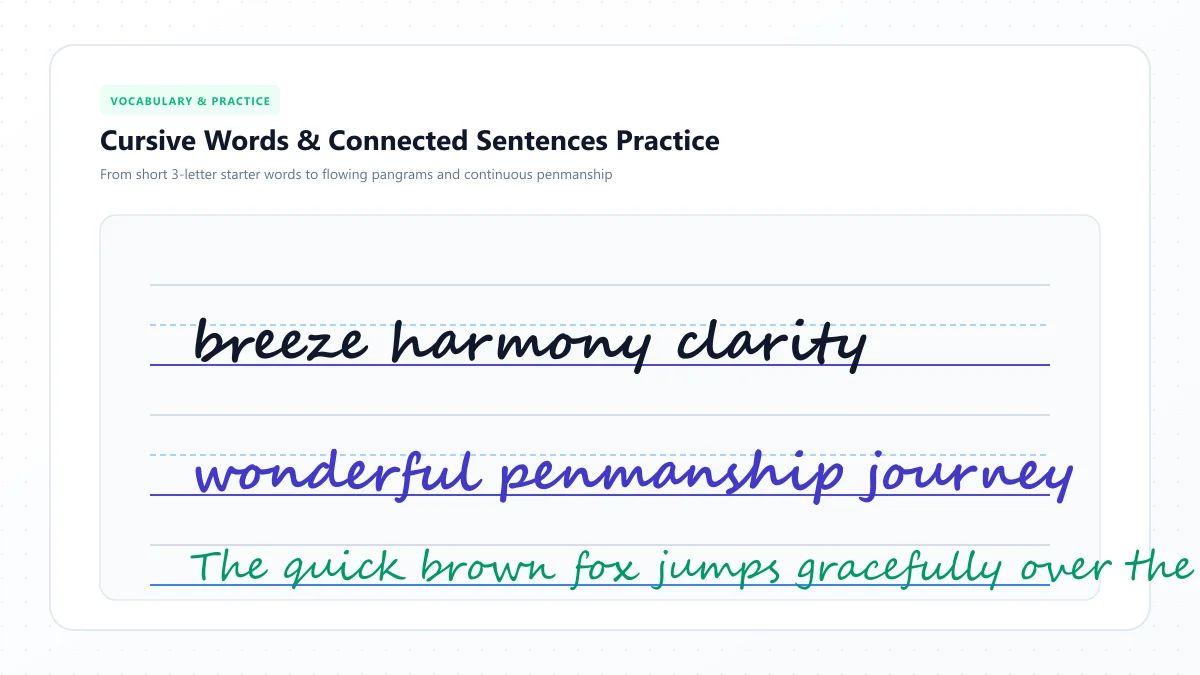
Looking for cursive words and sentences you can actually practice writing?
Sometimes you don't need another alphabet lesson. You already know what cursive letters look like, but you need the right words to practice connecting them, keeping your handwriting neat, and writing complete sentences without stopping after every letter.
That's exactly what this collection is for.
Below, you'll find 100 cursive handwriting practice examples, including 60 words and 40 sentences. They progress from easy three-letter words to longer vocabulary, everyday sentences, and more challenging handwriting exercises.
Whether you're helping a child practice cursive, working on your own penmanship, or returning to handwriting as an adult, you can start wherever you feel comfortable.
All you need is a pen or pencil, some lined paper, and a few minutes of focused practice.
100 Cursive Words and Sentences at a Glance
This collection includes six groups of words and four groups of sentences.
Practice category | Number of examples | Main skill |
|---|---|---|
Easy three-letter words | 10 | Simple lowercase connections |
Four-letter words | 10 | Smooth joins and spacing |
Five-letter words | 10 | Longer connected movements |
Words with loops | 10 | Ascenders and descenders |
Words with repeated letters | 10 | Letter separation and rhythm |
Longer practice words | 10 | Fluency across multiple connections |
Short beginner sentences | 10 | Capitals and word spacing |
Everyday sentences | 10 | Natural handwriting |
Sentences for handwriting control | 10 | Consistency and longer lines |
Advanced practice sentences | 10 | Sustained writing and varied letters |
Total | 100 | Words and sentences |
You don't have to complete the exercises in order. If you already know how to connect simple lowercase letters, jump to the five-letter words or sentences.
If you're still learning the basic strokes, our Cursive Alphabet Chart can help you review individual letter shapes first.
How to Practice Cursive Words and Sentences
Before starting the examples, use this simple method to make your handwriting sessions more productive.
Step 1: Read the word or sentence. Identify any letters that may be difficult to connect.
Step 2: Write slowly. Pay attention to the shape, spacing, and height of each letter.
Step 3: Repeat it. Write the example two or three times rather than immediately moving to the next one.
Step 4: Check your writing. Can you read it easily? Are the connections smooth and the word spaces clear?
Step 5: Try it without looking. Cover the example and write it from memory.
Remember that cursive handwriting styles differ. Some letters have high exits, others connect near the baseline, and certain letterforms require deliberate pen lifts.
Use the connecting movements taught by your chosen handwriting method.
1. Easy Three-Letter Cursive Words (Examples 1–10)
Three-letter words are useful for beginners because they let you concentrate on a small number of connections.
Practice these first:
# | Word | What to practice |
|---|---|---|
1 | cat | Rounded letter formation |
2 | sun | Smooth curved strokes |
3 | pen | Short letter connections |
4 | run | Lowercase r and n |
5 | dog | Oval and descending loop |
6 | sit | Short strokes and crossbars |
7 | cup | Rounded shapes and lower extension |
8 | map | Repeated arches and ovals |
9 | fun | Tall and short letter combinations |
10 | red | Small curves and ascenders |
Practice exercise
Start with cat, sun, and pen.
Write each word three times, concentrating on the movement between the letters.
Then try writing all three words in one line with clear spaces between them.
Don't rush. The aim is to build recognizable letter shapes and comfortable transitions.
2. Easy Four-Letter Cursive Words (Examples 11–20)
Four-letter words add one more connection and give you a chance to develop a steadier writing rhythm.
# | Word | What to practice |
|---|---|---|
11 | love | Oval and high-exit connections |
12 | moon | Repeated rounded letters |
13 | rain | Different exit and entry strokes |
14 | tree | Tall letters and repeated e |
15 | home | Ascending letters and arches |
16 | bird | Loop and curved letter transitions |
17 | star | Short letters and a rounded ending |
18 | fish | Tall and short letterforms |
19 | blue | High-exit connections |
20 | kind | Tall strokes and connected arches |
Practice exercise
Write:
moon, love, blue
Pay particular attention to the difference between low joins and higher connections.
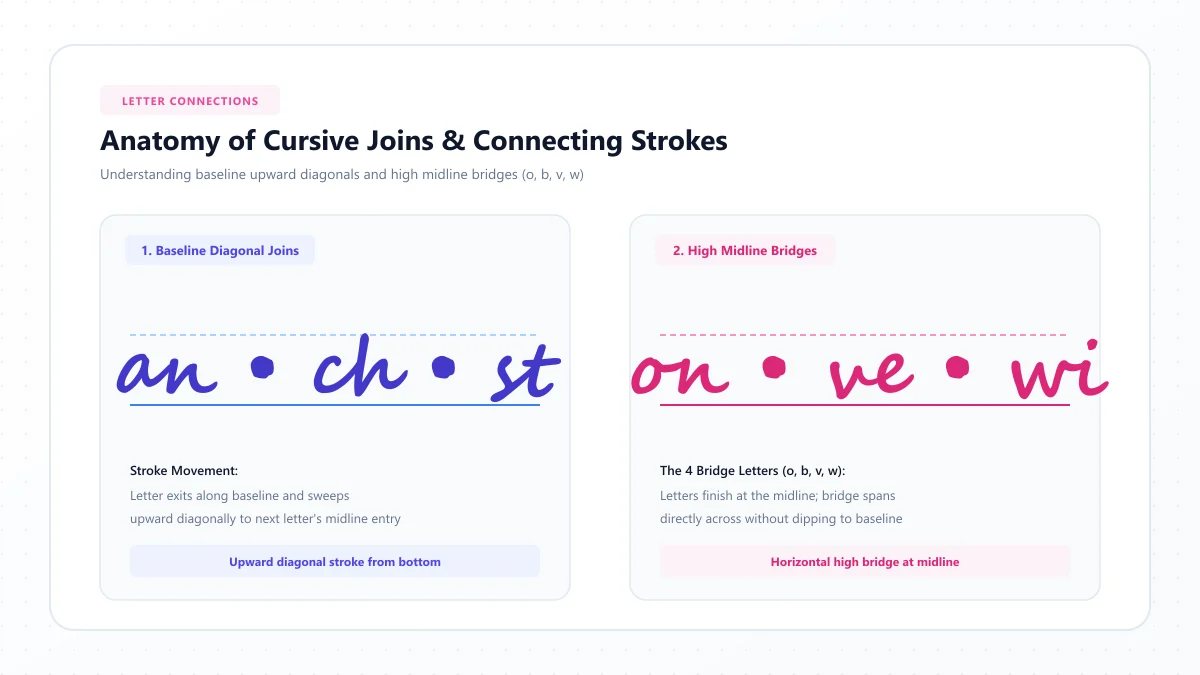
For example, certain cursive versions of o and v finish higher than letters such as a or i. This changes how you move into the following letter.
If those transitions are difficult, review our separate guide on how to connect cursive letters.
3. Five-Letter Cursive Words (Examples 21–30)
Five-letter words are ideal for practicing a longer sequence of movements.
They also introduce more opportunities to work on spacing and slant.
# | Word | What to practice |
|---|---|---|
21 | apple | Repeated letters and ascending loops |
22 | happy | Descending loops and repeated letters |
23 | water | Repeated curves |
24 | smile | Smooth letter transitions |
25 | green | Repeated e and rounded letters |
26 | house | High and low joins |
27 | light | Tall letters and descending movement |
28 | dream | Curves and connected arches |
29 | river | Narrow lowercase forms |
30 | sweet | High joins and repeated letters |
Practice exercise
Choose apple, happy, and water.
Write each word twice.
For the first attempt, focus on making the individual letters recognizable.
For the second, try to maintain an even writing rhythm without sacrificing clarity.
4. Cursive Words With Loops (Examples 31–40)
Loops are a recognizable feature of many traditional cursive handwriting styles.
Some rise above the main writing zone, while others descend below the baseline.
The goal is to keep loops controlled and proportionate.
# | Word | Main focus |
|---|---|---|
31 | hello | Ascending loops |
32 | yellow | Ascending and descending loops |
33 | flower | Tall loop forms |
34 | butterfly | Ascenders and descending letterforms |
35 | jelly | Tall and descending movements |
36 | holiday | Mixed ascenders and descenders |
37 | playful | Tall letters and descending loops |
38 | flying | Long loop sequence |
39 | helping | Ascending and descending strokes |
40 | lovely | Multiple tall and descending shapes |
Practice exercise
Write yellow, flying, and lovely on lined paper.
Make sure your ascending letters reach approximately the same height.
Then check that descending loops have enough room below the baseline without colliding with the next writing line.
Loop shapes differ between handwriting methods, so use the form taught by your chosen script.
5. Cursive Words With Double Letters (Examples 41–50)
Double letters are useful for developing consistent spacing.
If repeated letters are too close together, they can appear to merge. If they're too far apart, the word may look disconnected.
# | Word | Double-letter practice |
|---|---|---|
41 | little | tt |
42 | coffee | ff, ee |
43 | balloon | ll, oo |
44 | letter | tt |
45 | happy | pp |
46 | rabbit | bb |
47 | summer | mm |
48 | butter | tt |
49 | kitten | tt |
50 | success | cc, ss |
Practice exercise
Start with little, balloon, and coffee.
Compare the repeated letters.
For balloon, make sure both lowercase l forms and both o shapes are individually recognizable.
For coffee, notice that the two f forms may require different handling depending on the cursive style you're using.
Avoid adding unnecessary decorative loops that make the repeated letters hard to read.
6. Longer Cursive Practice Words (Examples 51–60)
Longer words help you practice maintaining a consistent handwriting style over multiple connections.
They're especially useful once short words begin to feel comfortable.
# | Word | Main focus |
|---|---|---|
51 | beautiful | Mixed letterforms |
52 | handwriting | Long connected sequences |
53 | wonderful | Multiple joining patterns |
54 | sunshine | Smooth lowercase transitions |
55 | adventure | Repeated arches and curves |
56 | friendship | Tall and descending letters |
57 | imagination | Repeated rounded and narrow forms |
58 | creativity | Different connection heights |
59 | happiness | Double letters and word rhythm |
60 | celebration | Long continuous writing |
Practice exercise
Choose two words from this group.
Write each one slowly on a separate line.
Then write it again at a comfortable natural pace.
Compare your attempts.
Did the second version become crowded? Did the letter height change toward the end of the word? Were any letters difficult to recognize?
Use those observations to identify what needs more practice.
7. Short Cursive Sentences for Beginners (Examples 61–70)
Once you can write individual words comfortably, move to complete sentences.
Short sentences introduce capital letters, spaces, and punctuation without making the exercise too demanding.
- I love my cat.
- The sun is warm.
- We like to read.
- My dog can run.
- I see a bird.
- The sky is blue.
- Mom has a pen.
- It is a nice day.
- We play in the park.
- The moon is bright.
Practice exercise
Choose three sentences.
Write each one on a separate line.
Pay attention to capital letters at the beginning, consistent lowercase sizes, and clear spaces between words.
For example, in The sun is warm., make sure the spaces are larger than the joins within each word.
8. Everyday Cursive Practice Sentences (Examples 71–80)
These sentences reflect familiar situations, making them useful for both children and adults.
- I enjoy reading in the evening.
- My favorite color is green.
- We visited the park yesterday.
- The flowers bloom in spring.
- I wrote a letter to my friend.
- Every morning begins a new day.
- Please remember to bring your book.
- The little puppy loves to play.
- I drink water after my walk.
- Learning something new can be fun.
Practice exercise
Write two sentences without pausing after every word.
Try to keep a steady rhythm while maintaining legible handwriting.
Then check your letter sizes and spacing.
If your writing becomes less clear, slow down and repeat the difficult phrase rather than the entire sentence.
9. Beautiful Cursive Sentences for Handwriting Practice (Examples 81–90)
These sentences offer a slightly more expressive alternative to ordinary handwriting drills.
They're suitable for journal practice, personal notes, or simply enjoying the look of handwritten words.
- Small moments can create beautiful memories.
- Every new day brings a little hope.
- Kind words make ordinary days brighter.
- A peaceful mind enjoys simple things.
- Dreams grow when we keep trying.
- The quiet morning feels full of promise.
- Happiness often begins with gratitude.
- Let your creativity find its own path.
- A thoughtful letter can mean so much.
- Beautiful things take patience and care.
Practice exercise
Choose your favorite sentence.
Write it once in your natural cursive style.
Then write it a second time, focusing on a consistent slant and balanced letter spacing.
You can experiment with slightly more expressive capital letters, but avoid making them so decorative that the sentence becomes difficult to read.
10. Longer Cursive Sentences for Advanced Practice (Examples 91–100)
If shorter sentences feel comfortable, try these longer exercises.
They require you to maintain consistent handwriting across more words and several different letter combinations.
- The gentle breeze moved through the trees as the sun began to rise.
- Writing a few thoughtful sentences each day gives me time to slow down.
- The curious little kitten watched the colorful butterflies in the garden.
- A handwritten message can make an ordinary afternoon feel special.
- We packed our books, notebooks, pencils, and water before leaving home.
- The bright yellow flowers looked beautiful beside the old wooden fence.
- Learning a new handwriting style requires attention, patience, and practice.
- My grandmother keeps a collection of letters from family and friends.
- When I write slowly and carefully, my words become easier to read.
- The quick brown fox jumps over the lazy dog near the quiet river.
Practice exercise
Pick one sentence and write it across as many lines as needed.
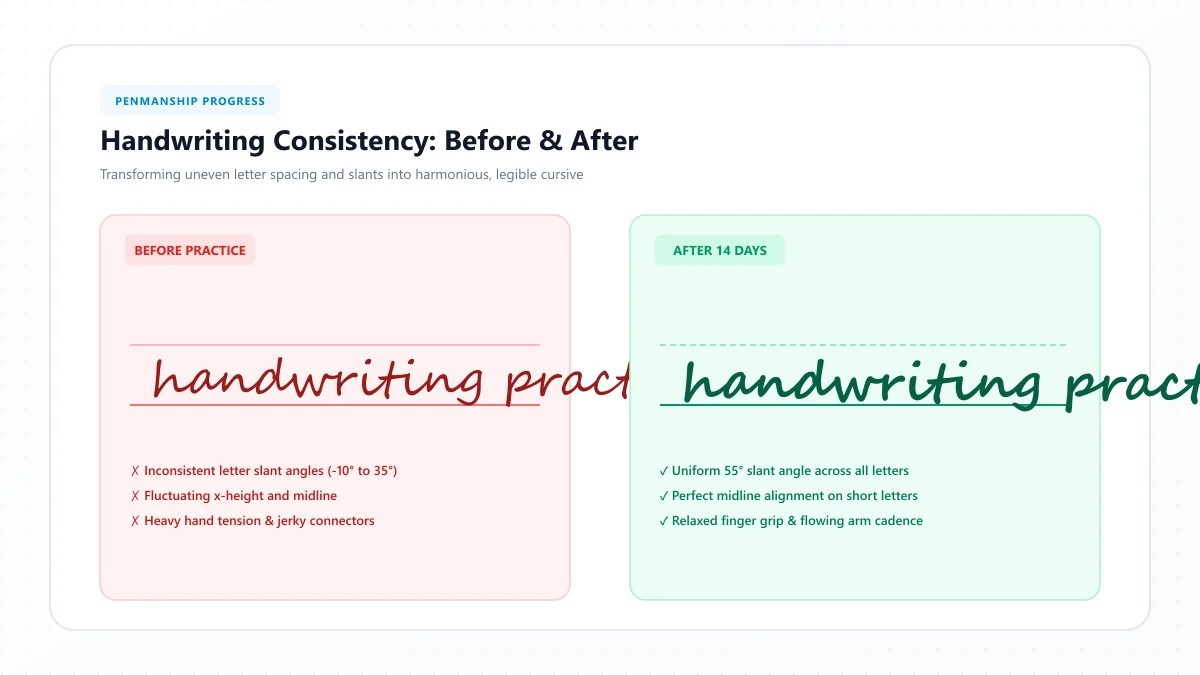
Focus on keeping your letter height, slant, and spacing consistent from beginning to end.
The final sentence contains the well-known pangram The quick brown fox jumps over the lazy dog, followed by additional words. Pangrams are useful because they contain every letter of the English alphabet.
You can repeat this exercise occasionally to review a broad range of letter shapes.
Which Cursive Words Should Beginners Practice First?
The best words for beginners are generally short, familiar, and made from letters they already know how to write.
For example, cat, dog, sun, and pen are manageable starting points.
Words such as moon and fish introduce different joining patterns, while love and light provide more loop practice.
A useful progression is:
- Three-letter words
- Four-letter words
- Five-letter words
- Words with loops and repeated letters
- Longer words
- Short sentences
- Longer sentences
If you find a particular word difficult, return to the letter pair causing the problem.
You don't need to restart the entire alphabet.
How to Practice Cursive Sentences Without Making Mistakes
Writing sentences requires several skills at the same time.
You need to manage individual letter shapes, connections, word spacing, capital letters, punctuation, and line alignment.
A few simple habits can make sentence practice more effective.
Use lined paper
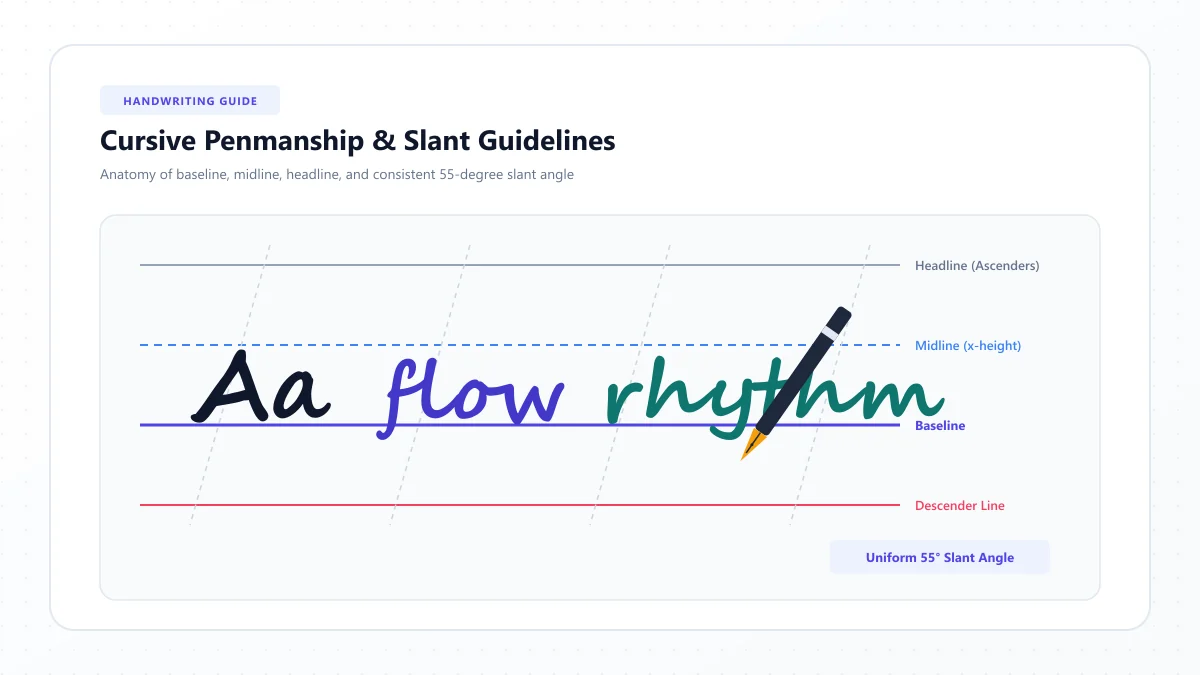
Guidelines help keep the main bodies of lowercase letters at a consistent height.
They also make it easier to see whether your writing drifts upward or downward.
Write at a comfortable speed
Avoid rushing.
Try to write smoothly while keeping every word recognizable.
Check word spacing
Leave a visible space between complete words.
This helps readers distinguish one word from the next.
Review capital letters
Check the first letter of every sentence.
If your cursive capitals are difficult, practice them separately before returning to sentence writing.
Add dots and crossbars carefully
Some cursive methods encourage writers to complete a word's main body before adding dots over i and j or crossing t.
Follow the sequence used by your chosen handwriting model.
Read your finished sentence
Ask yourself whether someone unfamiliar with your handwriting would understand it.
If not, identify the specific letters or connections that caused the problem.
Cursive Handwriting Practice for Kids
Children can use the shorter words and sentences in this collection to practice familiar vocabulary.
Start with just a few words, such as cat, sun, and dog.
When those feel comfortable, move on to short sentences such as The sun is warm. or We like to read..
Keep handwriting activities manageable and appropriate for the child's age and writing experience.
For example, you might ask a child to choose five favorite words, write them neatly, and illustrate one of them.
For teaching specific letterforms, use an age-appropriate handwriting curriculum and matching letter models.
A typed word list provides practice content, but it does not replace instruction in cursive stroke order.
Cursive Writing Practice for Adults
Adults can use these examples to refresh cursive handwriting or build a more consistent writing style.
If you already know the alphabet, you may not need to begin with isolated letter exercises.
Start with meaningful words and everyday sentences.
Try writing the names of friends or family members, a short journal entry, or a handwritten thank-you note.
You can also choose a few of the longer sentences and practice them as part of a regular routine.
Focus on readability and writing comfort rather than trying to create perfect calligraphy.
A 10-Minute Daily Cursive Practice Routine
You can turn the examples above into a short daily handwriting exercise.
Time | Activity |
|---|---|
Minutes 1–2 | Warm up with simple curves and loops |
Minutes 3–4 | Write five short practice words |
Minutes 5–6 | Practice two words with difficult connections |
Minutes 7–9 | Write two complete sentences |
Minute 10 | Review letter size, spacing, and readability |
Choose different examples on different days.
Some sessions may focus on loops, while others may focus on repeated letters or longer sentences.
If ten minutes feels too long, shorten the routine. If your handwriting becomes uncomfortable, take a break.
The purpose is focused practice, not filling as many lines as possible.
A 7-Day Cursive Words and Sentences Practice Plan
Here's a simple way to use the full collection over one week.
Day | Practice focus | Examples |
|---|---|---|
Monday | Three-letter words | 1–10 |
Tuesday | Four-letter and five-letter words | 11–30 |
Wednesday | Loop practice | 31–40 |
Thursday | Repeated and longer words | 41–60 |
Friday | Beginner sentences | 61–70 |
Saturday | Everyday and expressive sentences | 71–90 |
Sunday | Longer sentences and review | 91–100 |
You can split any section across additional days.
This routine is designed to organize your practice, not to guarantee mastery in seven days.
How to Make Your Own Cursive Practice Sentences
Once you've used the examples in this guide, try creating sentences based on your own interests.
Start with familiar vocabulary.
For example, if you enjoy gardening, you could write:
The roses need water every morning.
If you like reading:
Reading before bed helps me relax.
If you're practicing handwriting for school:
Today we studied history and geography.
Personal sentences can make practice more meaningful because you're writing something you might naturally want to say.
You can also create sentences containing your most difficult letters or letter pairs.
If you struggle with r, try:
Roberta brought three red roses home.
If you want to practice l, try:
Lily loves little yellow balloons.
The best practice sentences are those that help you work on a real handwriting challenge.
Using an Online Cursive Writing Generator for Practice
An online cursive writing tool can help you explore how words and sentences appear in digital script styles.
For example, you can enter a word such as beautiful or a sentence such as The quick brown fox jumps over the lazy dog near the quiet river. and compare different visual styles.
Our Cursive Writing Generator provides a digital writing canvas, while the Cursive Text Generator offers decorative copyable text.
However, digital cursive lettering and physical handwriting are not exactly the same.
A generated script preview may not show the correct starting point, pen direction, or joining method used in a school handwriting curriculum.
For physical handwriting practice, combine suitable instructional models with the words and sentences in this article.
Frequently Asked Questions About Cursive Words and Sentences
What are the easiest cursive words to write?
Short, familiar words such as cat, dog, sun, pen, and run are useful starting points. The easiest words will depend on which lowercase letters and connections you've already learned.
What are some good cursive practice sentences?
Examples include The sun is warm., We like to read., and My dog can run.. Begin with short sentences before moving on to longer ones.
How many cursive words should I practice every day?
There's no required number. You might start with five words and one or two sentences, then adjust the amount based on your comfort and progress.
What words help practice cursive loops?
Words such as love, light, flower, holiday, and balloon provide opportunities to practice ascending and descending letterforms.
What words are good for practicing double letters?
Try little, coffee, balloon, letter, and kitten. These words help you practice keeping repeated letters separate and recognizable.
What is a good sentence for practicing the entire cursive alphabet?
The quick brown fox jumps over the lazy dog contains every letter of the English alphabet and is commonly used for handwriting practice.
Can adults use cursive practice words and sentences?
Yes. Adults can use the same examples to improve handwriting consistency, develop a comfortable writing rhythm, and practice longer connected words.
Should I practice cursive words or sentences first?
Words are generally easier when you're still learning joins. Once you can write familiar words comfortably, begin practicing short sentences.
Do all cursive letters need to stay connected?
No. Cursive styles have different joining rules, and some letterforms require pen lifts. The aim is smooth, readable handwriting rather than one uninterrupted line.
Can I practice cursive without printable worksheets?
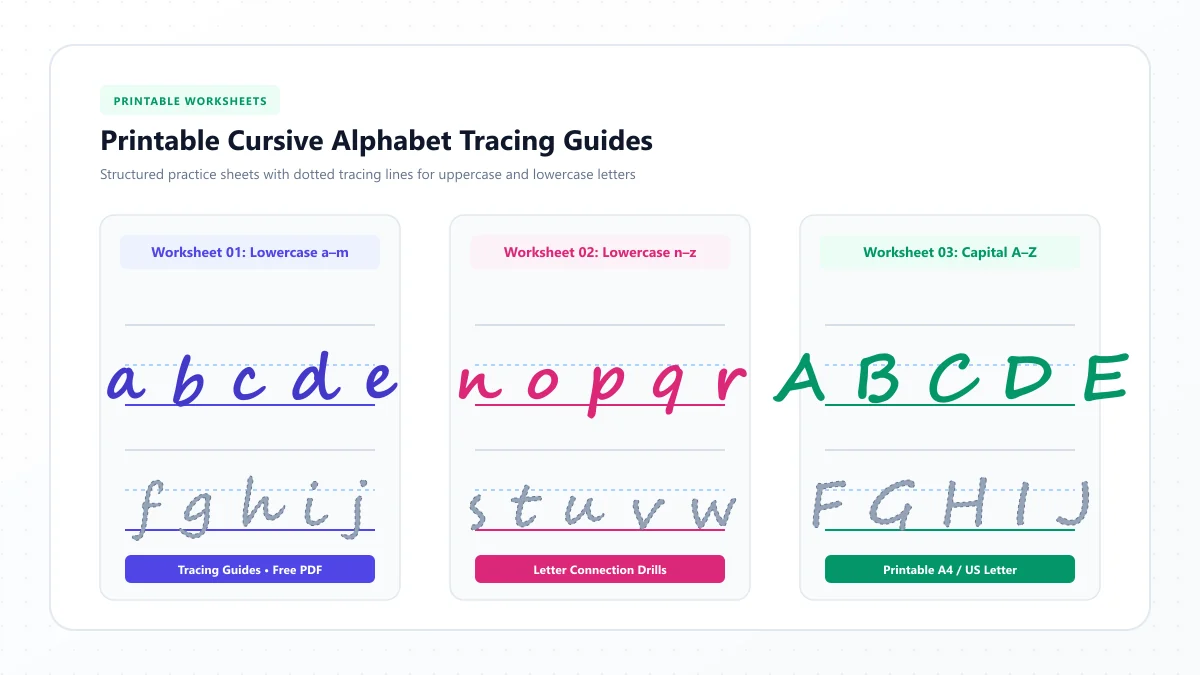
Yes. Ordinary lined paper and reliable cursive letter references are enough to begin. Printable worksheets are helpful for additional structure but are not required.
Final Thoughts
Improving cursive handwriting doesn't have to mean repeating the entire alphabet every day.
Practicing meaningful words and sentences gives you a chance to use the shapes and connections you've already learned.
Start with the easier examples, move toward longer words, and gradually practice complete sentences. Pay attention to letter size, connections, spacing, and readability.
Most importantly, choose exercises that address your own handwriting challenges.
With these 100 cursive words and sentences, you have a ready-to-use collection for beginner practice, classroom activities, adult handwriting review, or a short daily writing routine.
For additional help, explore our Cursive Alphabet Chart, visit the Cursive Letters Directory, or try our Cursive Writing Generator for digital script-style examples.
References and further reading
- Reading Rockets — Multisensory techniques for teaching handwriting
- Learning Without Tears — handwriting curriculum publisher
These links are provided for further reading. External websites and information may change.