Learning cursive handwriting becomes much easier when you have something to practice on. A blank notebook is useful, but if you're still figuring out how to form a lowercase a or connect two letters smoothly, guided practice sheets can give you a clearer place to start.
That's where cursive writing worksheets come in.
Whether you're a parent helping your child, a teacher preparing handwriting activities, or an adult learning cursive for the first time, printable worksheets let you practice at a comfortable pace.
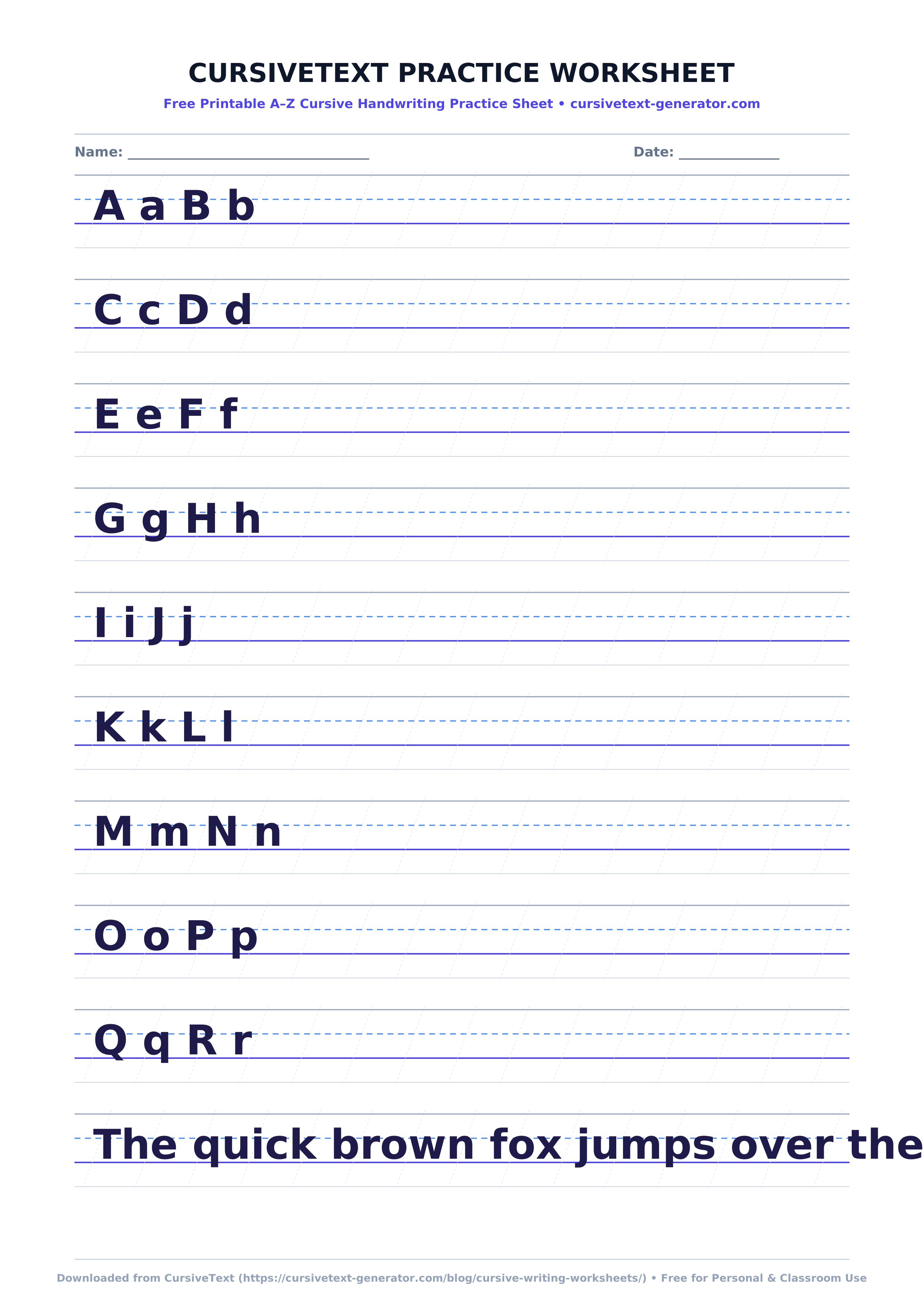
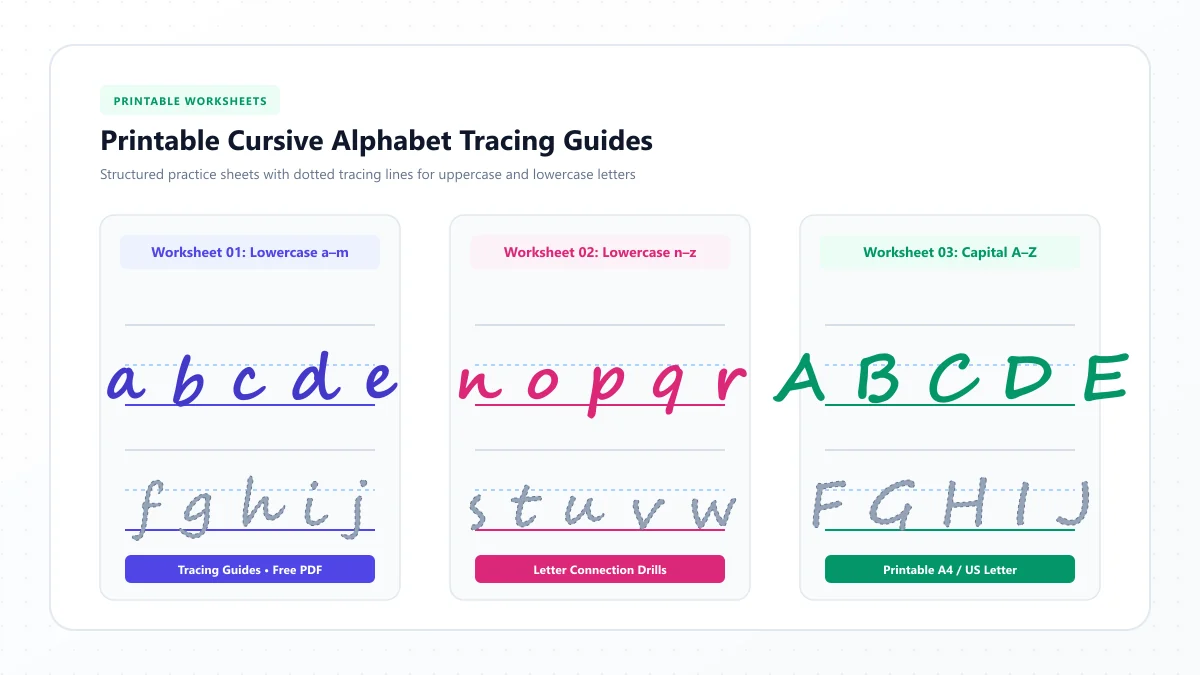
We've put together a free 30-page cursive writing practice pack with uppercase and lowercase A–Z letter sheets, tracing examples, word practice, sentence exercises, and blank handwriting paper.
You can print the whole pack or choose just the pages you need. There's no need to work through every letter in one sitting.
Download Free Printable Cursive Writing Worksheets (PDF)
Looking for cursive handwriting practice sheets you can print today?
Our free printable PDF includes 30 pages designed for beginners who want to become more familiar with script-style letters and handwriting practice.
[Download Free Cursive Writing Worksheets – 30-Page PDF]
The download includes:
- 26 individual A–Z letter worksheets
- Uppercase and lowercase script-style letter examples
- Light-colored letters for tracing practice
- Guided handwriting lines for independent writing
- A practice word for each letter
- A page for practicing connected words
- A page with short practice sentences
- Blank ruled handwriting paper
PDF details
Feature | Details |
|---|---|
Format | Printable PDF |
Total pages | 30 |
Letter coverage | Uppercase and lowercase A–Z |
Main activities | Trace, copy, and write independently |
Paper size | US Letter; scalable for A4 |
Suitable for | Children, teens, and adult beginners |
Cost | Free |
The worksheets use decorative script-style examples and handwriting guidelines. They are useful for practicing letter shapes and pen control, but they do not prescribe a particular school handwriting method or provide directional stroke arrows.
For detailed letter formation, you can use our Cursive Letters Directory alongside the printable sheets.
What Are Cursive Writing Worksheets?
Cursive writing worksheets are practice pages designed to help learners recognize, trace, copy, and write cursive-style letters.
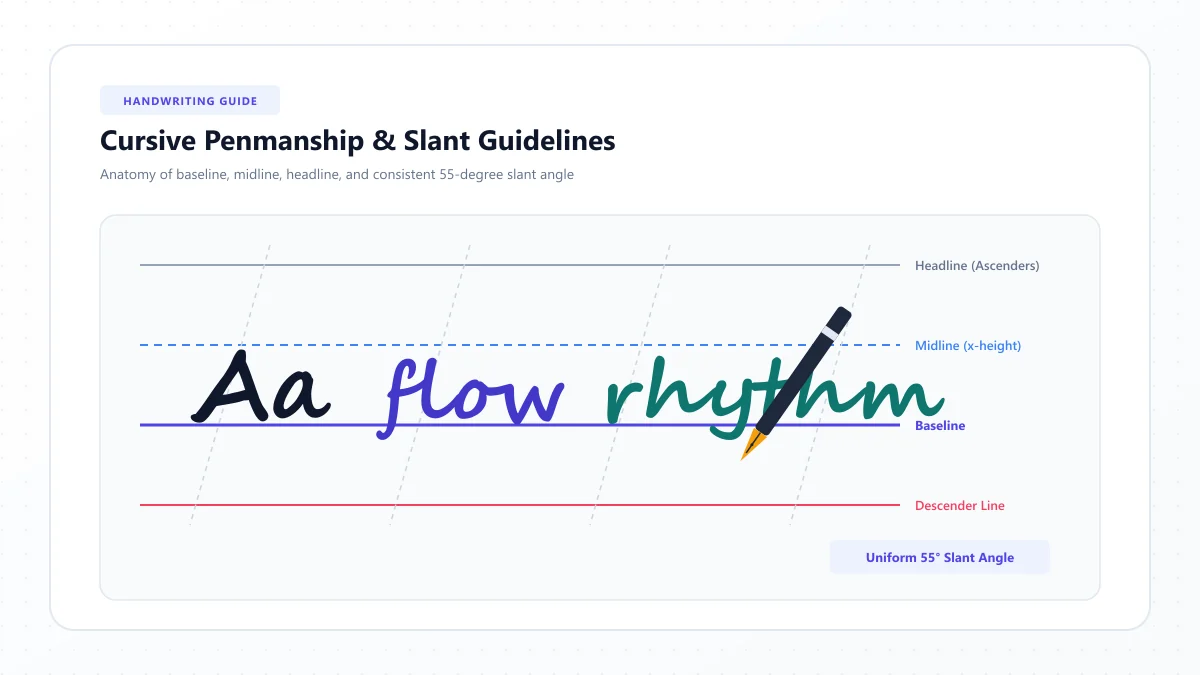
Unlike ordinary lined notebook paper, handwriting worksheets may include model letters, lighter tracing examples, midlines, baselines, and blank spaces for independent practice.
A good worksheet encourages you to gradually rely less on the examples and more on your own handwriting.
For instance, if you're practicing lowercase a, you can start by studying the letter, trace it a few times, and then try drawing the same shape without tracing.
This approach can be used with the entire alphabet before moving to connected words and sentences.
Why use printable cursive practice sheets?
Printable worksheets offer several practical advantages.
You can practice one letter at a time. Instead of dealing with 26 letters at once, focus on whichever shapes need more attention.
You have a consistent writing space. Guidelines help you see whether your letters are too tall, too short, or unevenly spaced.
You can repeat difficult exercises. Print another copy whenever you want to practice a particular letter again.
They're useful at home or in the classroom. Parents, teachers, homeschool families, and adult learners can choose exercises based on their needs.
Most importantly, worksheets turn a broad goal like "improve my cursive" into manageable activities you can complete in a few minutes.
Free Cursive Alphabet Worksheets A–Z
Our printable alphabet pack contains an individual practice sheet for every letter from A to Z.
Each letter worksheet includes uppercase and lowercase examples, tracing rows, independent writing space, and a sample word.
Instead of memorizing the alphabet in one sitting, work through a small selection of letters and move forward when you feel comfortable.
A–Z cursive letter practice list
Letter | Practice word | Main focus |
|---|---|---|
A a | apple | Rounded lowercase shape |
B b | bird | Tall letter formation |
C c | cat | Open curves |
D d | dog | Oval and ascending stroke |
E e | egg | Small, smooth curves |
F f | fish | Tall strokes and loops |
G g | garden | Descending letter shapes |
H h | hello | Tall strokes and arches |
I i | ice | Short strokes and dots |
J j | jump | Descending strokes and dots |
K k | kite | Tall strokes and branching shapes |
L l | love | Ascending loops |
M m | moon | Repeated arches |
N n | name | Rounded connecting movements |
O o | orange | Closed oval shapes |
P p | paper | Downward extensions |
Q q | queen | Oval and descending strokes |
R r | rain | Small shoulders and joins |
S s | sun | Curved letter formation |
T t | tree | Tall strokes and crossbars |
U u | under | Repeated undercurves |
V v | very | Smooth changes in direction |
W w | water | Repeated valley movements |
X x | box | Crossing strokes |
Y y | yellow | Downward loops |
Z z | zebra | Distinctive curved forms |
Use this list to select the letters and words you want to practice.
If you need a complete visual reference for capital and lowercase forms, visit our Cursive Alphabet Chart.
Lowercase Cursive Writing Worksheets
Lowercase letters are a good place to begin because they appear so frequently in everyday words.
When learners become comfortable with short lowercase letters, they can start recognizing repeated movements across different words.
You don't have to practice the alphabet in alphabetical order. Grouping letters by similar shapes can make practice more manageable.
Start with simple strokes
Begin with letters such as:
i, u, t, w
These letters introduce upward curves, repeated movements, and relatively simple letter structures.
Try writing each letter several times before using it in short combinations such as it, wit, and unit.
Move to rounded letters
Next, try:
a, c, d, g, o, q
These letters share rounded shapes, although their stroke sequences and connections vary between cursive methods.
Practice making the rounded sections evenly sized.
Practice tall letters and loops
Letters such as:
b, h, k, l, f
require additional attention because parts of the letters extend above the typical lowercase writing zone.
Keep loops proportional and avoid making them so narrow that they look like straight lines.
Add descending letters
Practice letters such as:
g, j, p, q, y, z
These include forms with tails or other parts extending below the baseline.
Use the lower writing space rather than squeezing the entire letter into the middle zone.
Practice tip: Some letters fit more than one shape category, and different handwriting methods group letters differently. Use these categories as a convenient practice sequence rather than a strict curriculum.
Uppercase Cursive Writing Worksheets
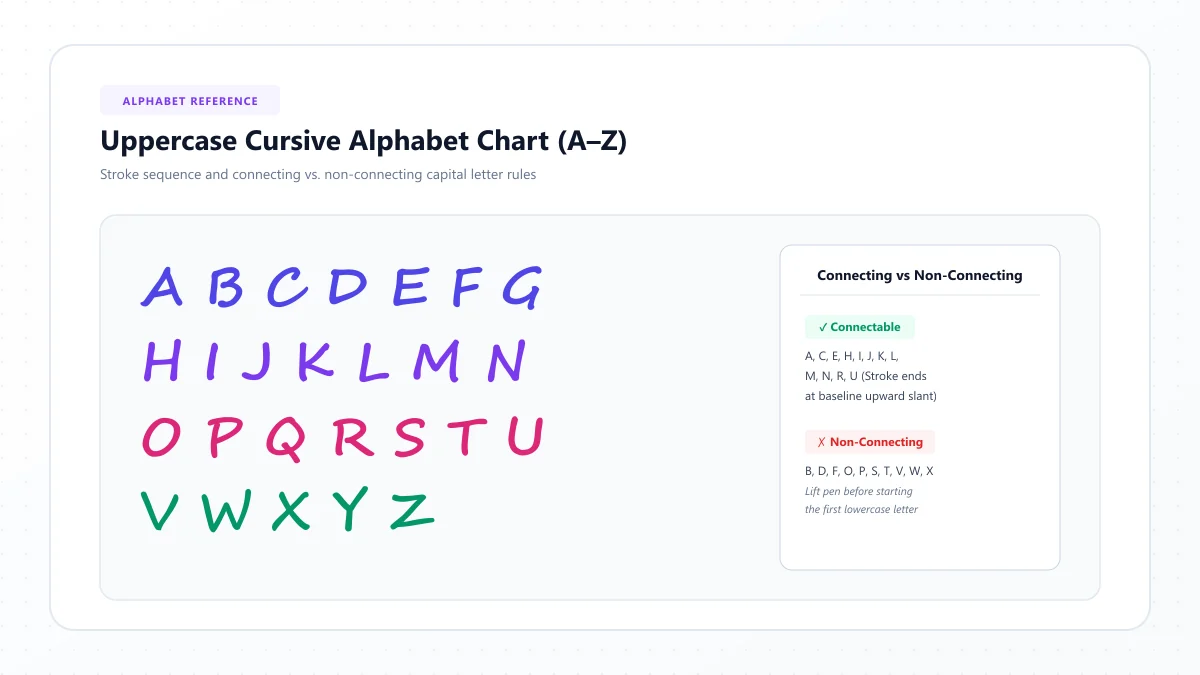
Capital cursive letters can look quite different from their printed equivalents.
Some traditional capital letters have elaborate loops, while modern school handwriting styles may use simpler shapes.
Our printable pack includes uppercase examples alongside lowercase letters so learners can practice both.
A simple way to work with capital letters is to choose a familiar name.
For example:
- A — Alice
- B — Benjamin
- C — Charlotte
- D — Daniel
- E — Emma
- J — James
- L — Lily
- M — Michael
- S — Sarah
Start by practicing the first capital letter on its own.
Next, write the complete name, paying attention to the space between the capital and the following lowercase letter.
Some cursive styles connect capital letters directly to lowercase letters, while others use a small pen lift. Follow the method you're learning rather than forcing an awkward connection.
If a particular letter feels difficult, look at its individual learning guide before returning to the worksheet.
How to Use Cursive Writing Worksheets Step by Step
Simply tracing rows of letters isn't always enough to develop comfortable handwriting.
Try following a short routine that moves from guided examples to independent writing.
Step 1: Study the example
Before picking up your pencil, examine the letter.
Look at its overall shape, height, slant, and position on the writing lines.
Ask yourself:
- Does the letter contain a loop?
- Is it short or tall?
- Does part of it extend below the baseline?
- Where will the next connected letter begin?
For correct stroke direction and order, use a demonstrated letter-formation lesson rather than relying on the static shape alone.
Step 2: Trace slowly
Follow the light script examples on the worksheet.
Use smooth movements without pressing too hard.
If you find yourself rushing, stop and focus on making just one carefully formed letter.
Step 3: Copy the shape
Now use the blank guided rows to copy the example without tracing directly over it.
Compare your letter with the model.
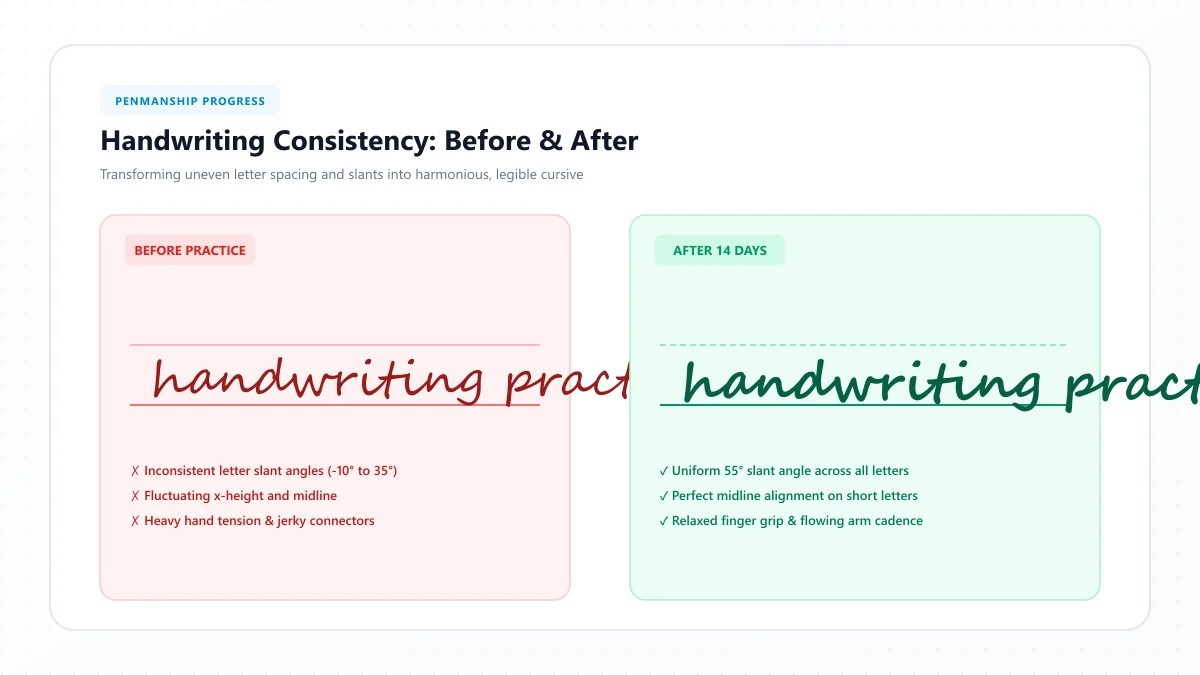
The aim isn't to create an identical drawing. You're trying to produce a consistent, recognizable letter.
Step 4: Practice a word
Each alphabet worksheet includes a sample word.
Writing words gives you a chance to practice several letters together and notice how spacing changes.
For example, after practicing the letter a, try writing cat or apple.
Step 5: Write independently
When you're comfortable, cover the example and write the letter or word from memory.
Then check your work.
Can you recognize every letter? Are the sizes consistent? Do the joins look natural?
Repeat whichever part needs attention.
Cursive Handwriting Worksheets for Kids
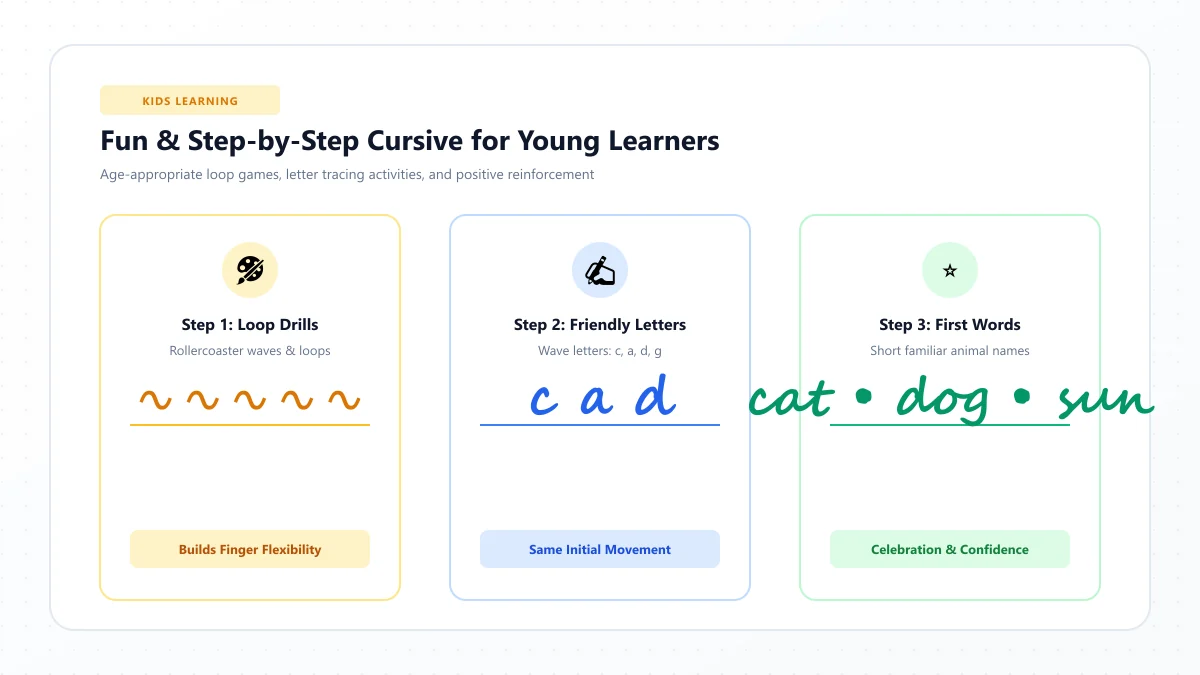
For children, handwriting practice works best when activities are manageable and suited to their current writing ability.
Children who can already recognize letters and form basic printed shapes may be ready to explore cursive letterforms, depending on their school's teaching approach.
There isn't one universal age when every child should begin cursive.
Make practice short and enjoyable
Try a few minutes of focused handwriting instead of asking a young learner to complete many pages at once.
Choose familiar words such as:
- cat
- dog
- mom
- dad
- sun
- book
- apple
- happy
Children may enjoy practicing the letters in their own names before working through more unfamiliar words.
Use positive, specific feedback
Rather than saying "write more neatly," point out something clear and achievable.
For example:
"Your lowercase a is easy to recognize. Now try keeping the next three letters the same height."
This gives the learner a practical goal for the next attempt.
Try simple handwriting activities
You can make cursive worksheets more engaging by connecting practice to everyday activities.
Name practice: Write first names or the names of family members.
Word matching: Match a cursive word to its printed equivalent.
Favorite things: Practice the names of pets, colors, foods, or hobbies.
Short notes: Write a birthday greeting or a thank-you message.
These activities add a meaningful reason to practice without turning handwriting into a lengthy assignment.
Cursive Writing Worksheets for Adults
Cursive practice isn't just for children.
Adults may want to learn cursive to read handwritten letters, improve their own handwriting, create a more comfortable writing style, or reconnect with a skill they learned years ago.
You can use the same printable worksheets without following a school-style lesson schedule.
Start with familiar words
Instead of beginning with every letter, practice words that you already write regularly.
Useful examples include:
- your first name
- your last name
- your city
- the days of the week
- common greetings
- short personal notes
Focus on comfort and readability
Don't worry about creating elaborate, decorative handwriting.
Try to keep your letters recognizable, your spacing consistent, and your hand relaxed.
If larger writing feels easier, use more space on the practice lines.
Build a personal practice routine
You might practice individual letters one day, familiar words the next, and complete sentences after that.
Use the blank ruled worksheet to review your progress over time.
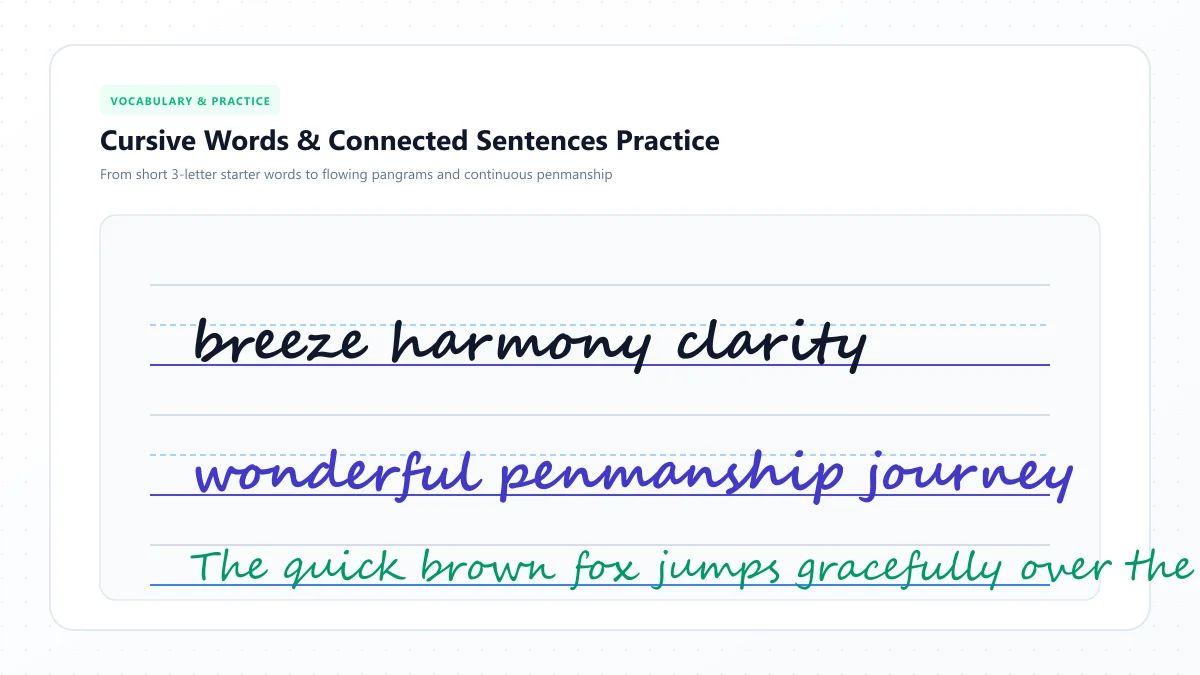
Printable Cursive Word Practice Sheets
Learning individual letters is only the beginning.
Once you recognize the basic letterforms, the next step is writing words with smoother transitions.
Our PDF includes a dedicated word-practice page.
Here are additional words you can use on the blank worksheets.
Easy three-letter words
- cat
- sun
- pen
- run
- day
- red
- sit
- fun
- art
- dog
These words are short enough to make repeated practice manageable.
Four- and five-letter words
- love
- home
- rain
- moon
- tree
- smile
- apple
- happy
- water
- hello
Try writing each word a few times.
Look for places where the letters feel crowded or the connections become awkward.
Longer words for additional practice
When you're ready, try:
- beautiful
- sunshine
- wonderful
- butterfly
- friendship
- handwriting
- adventure
- imagination
Longer words give you a chance to practice spacing, rhythm, and multiple connections.
If a particular combination causes problems, return to the two letters involved and practice them separately.
Cursive Sentence Practice Worksheets
Writing complete sentences helps you move beyond isolated letters and words.
Start with short sentences that feel easy to remember.
Our printable pack includes a sentence-practice page, and you can copy the examples below onto the blank handwriting sheet.
Beginner cursive sentences
- I love my family.
- The sun is shining.
- My name is Emma.
- We have a little dog.
- I like reading books.
Intermediate practice sentences
- Every day is a chance to learn something new.
- The beautiful flowers bloom in spring.
- Practice helps me become a more confident writer.
- A small act of kindness can brighten someone's day.
- Writing a thoughtful note is a lovely way to connect.
Full alphabet practice
Try writing:
The quick brown fox jumps over the lazy dog.
This well-known sentence contains all 26 letters of the English alphabet.
It can be useful for reviewing different letter shapes, but beginners should focus on shorter exercises before attempting long sentences.
A 7-Day Cursive Worksheet Practice Plan
Want a simple way to organize your practice?
Use this seven-day plan as a starting point.
Day | Worksheet focus | Activity |
|---|---|---|
Monday | Simple lowercase letters | Trace and copy i, u, t, and w |
Tuesday | Rounded letters | Practice a, c, d, g, o, and q |
Wednesday | Tall and looped letters | Work on b, h, k, l, and f |
Thursday | Descending and remaining letters | Review j, p, r, s, v, x, y, and z |
Friday | Uppercase alphabet | Practice capital letters and names |
Saturday | Word practice | Complete the connected-word worksheet |
Sunday | Sentence practice | Write short sentences and review difficult letters |
This is a flexible practice schedule, not a promise of mastering cursive in seven days.
Repeat any day as needed. Consistent practice with correct letter formation is more useful than finishing every page quickly.
How to Print Cursive Worksheets Correctly
The PDF is designed for convenient home and classroom printing.
Follow these steps to prepare your worksheets.
1. Download the PDF
Use the free download link near the beginning of this article and save the worksheet pack to your device.
2. Open the file
Open the PDF in a browser or PDF reader.
Check that the letter examples and handwriting guidelines are visible before printing.
3. Choose your paper size
The worksheets are designed for US Letter paper.
If you're using A4 paper, select Fit to Page or an equivalent scaling setting in your print dialog.
4. Select the pages you need
You don't have to print all 30 pages.
For example, if you're practicing letters A through E, you can print those five individual letter worksheets.
Printing only the required pages can help reduce paper and ink use.
5. Print and start practicing
Black-and-white printing is suitable for most activities.
Check that the lighter tracing examples remain visible. If they appear too faint, adjust your printer's quality settings.
Printing tip: Preview the document before printing a full classroom set, especially if your printer changes the scaling automatically.
Common Mistakes When Using Cursive Worksheets
Worksheets are helpful, but how you use them matters.
Here are some issues to watch for.
Tracing without learning the stroke movement
A printed example shows what a letter looks like, but it may not show where to begin or which direction to move.
Use stroke-order demonstrations or an appropriate handwriting curriculum alongside tracing exercises.
Practicing too many letters at once
Trying to complete the entire alphabet in one session can make practice tiring.
Choose a few letters and give them enough attention before moving on.
Ignoring the handwriting guidelines
The guidelines help establish proportions between short letters, ascenders, and descenders.
Pay attention to where the letters sit rather than treating the lines as decoration.
Copying mistakes repeatedly
If a shape feels incorrect, pause and compare it with a reliable reference.
Practicing an incorrect movement repeatedly can make it harder to change later.
Focusing on decorative appearance too early
Handwriting doesn't need elaborate flourishes to be attractive.
Build clarity and control first. You can explore more decorative lettering styles when you feel comfortable.
Cursive Worksheets vs. a Cursive Text Generator
Printable handwriting worksheets and online cursive text generators serve different purposes.
Cursive worksheets | Cursive text generator |
|---|---|
Help you practice handwriting movements | Converts typed text into decorative digital characters |
Designed for pen or pencil practice | Designed for copying, sharing, or displaying text |
Support letter formation and writing control | Provide visual typography variations |
Useful for handwriting lessons | Useful for bios, names, captions, and creative projects |
If you want to physically write cursive letters, printable practice sheets are the better starting point.
If you want to create stylish digital lettering, use our free Cursive Text Generator.
You can also explore the Cursive Writing Generator for digital handwriting-style examples.
Keep in mind that decorative script fonts and Unicode cursive characters do not necessarily follow the stroke shapes or connections taught in handwriting lessons.
Frequently Asked Questions About Cursive Writing Worksheets
Are these cursive writing worksheets really free?
Yes. The provided 30-page worksheet pack is free to download and print for personal, home, and classroom practice. It includes A–Z letter pages and extra writing exercises.
Do the worksheets include uppercase and lowercase cursive letters?
Yes. Each of the 26 letter sheets includes both uppercase and lowercase script-style examples, along with space for tracing and independent practice.
Can adults use these cursive handwriting worksheets?
Yes. The worksheets are suitable for adult beginners who want to practice letter shapes, writing control, familiar words, and short sentences.
What age should children start cursive worksheets?
It depends on the child's handwriting development and the approach used by their school. Many learners begin cursive after gaining confidence with basic printed letterforms. A teacher can help determine an appropriate starting point.
What is the best order for practicing cursive letters?
One practical approach is to begin with simple lowercase curves, move on to rounded letters and loops, and then practice capital letters, letter joins, words, and sentences. Individual school handwriting methods may recommend different sequences.
Can I print the worksheets on A4 paper?
Yes. The PDF uses US Letter pages, but you can generally print them on A4 by selecting Fit to Page in your printer settings.
Should I use a pen or pencil for cursive practice?
Either can work. A comfortable pencil is useful for beginners who want to erase mistakes. A smooth-writing pen can also be suitable if it allows comfortable, controlled movements.
How many cursive worksheets should I complete per day?
There's no fixed number. A few minutes of focused, accurate practice may be more useful than rushing through several pages. Choose an amount that feels manageable.
Can cursive worksheets improve handwriting?
Worksheets can support handwriting practice by providing consistent models and guidelines. Improvement depends on practicing appropriate letter movements, reviewing mistakes, and writing independently as well as tracing.
Do these worksheets teach traditional school cursive?
The pack uses decorative script-style lettering for tracing. It is not a certified D'Nealian, Zaner-Bloser, or other standardized handwriting curriculum. If you are teaching a specific method, use matching stroke-order resources alongside or instead of these sheets.
Start Practicing With Your Free Cursive Worksheets
Learning cursive doesn't have to mean filling an entire notebook with repeated letters.
A simple printable worksheet can help you focus on one shape, one word, or one small improvement at a time.
Start with the letters that feel easiest, use the guided lines, and move toward independent writing when you're ready. Whether you're practicing with a child, preparing a classroom activity, or learning as an adult, the most useful routine is one you can comfortably repeat.
For more learning resources, explore our Cursive Alphabet Chart, browse the A–Z Cursive Letters Directory, or try the Cursive Text Generator for decorative digital lettering.
References and further reading
- Zaner-Bloser — Handwriting free teaching resources
- Learning Without Tears — handwriting curriculum publisher
These links are provided for further reading. External websites and information may change.