Think about the last time you wrote something by hand. Maybe it was a quick shopping list, a birthday card, or a note you left on someone's desk.
Did you write each letter separately, or did your pen flow from one letter to the next?
Most of us develop a preferred handwriting style without thinking much about it. Some people naturally connect their letters, while others prefer the neat, separate shapes of print handwriting. Many use a combination of both.
But is one style actually better?
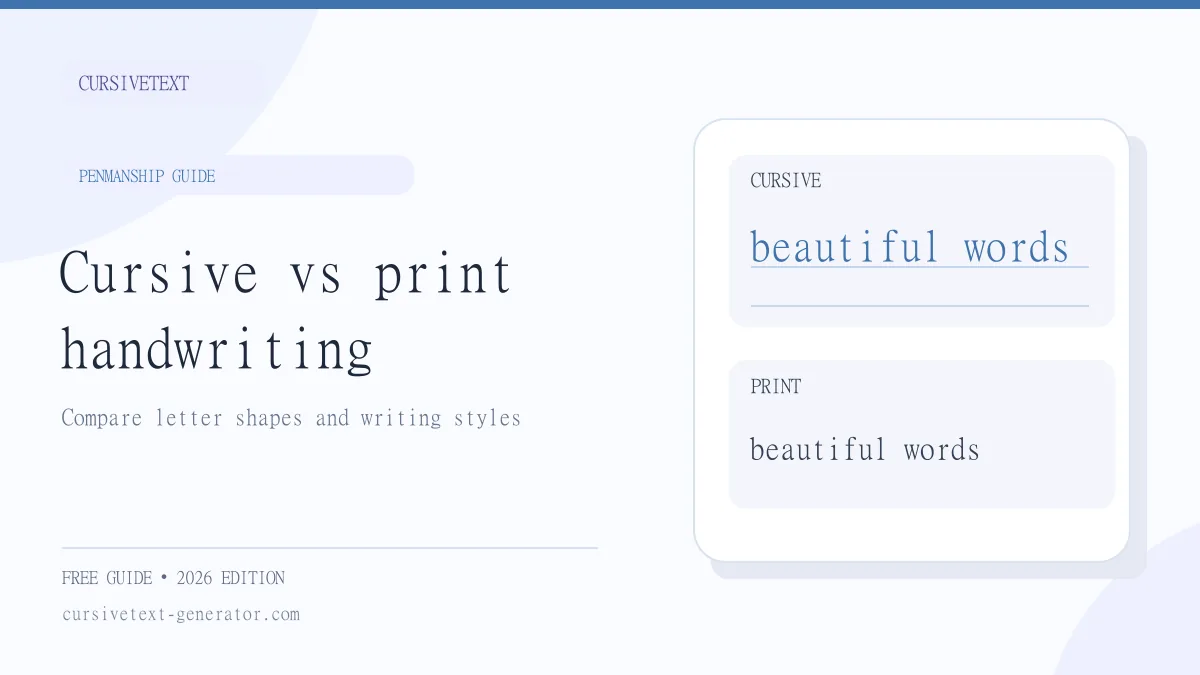
The main difference between cursive and print handwriting is how the letters are formed. Cursive typically connects letters through flowing strokes, while print handwriting forms most letters separately.
Both styles have advantages, and the best choice depends on your experience, purpose, and personal comfort.
In this guide, we'll compare cursive vs print handwriting, explore their benefits, examine the differences in speed and readability, and help you decide which style is worth learning.
What Is Cursive Handwriting?
Cursive handwriting is a style of writing in which letters are generally connected within words.
Instead of lifting your pen after forming each letter, you use a series of continuous or joined strokes.
This creates the flowing appearance that many people associate with handwritten letters, signatures, and traditional penmanship.
For example, when writing the word "beautiful" in cursive, most lowercase letters connect to the next letter.
The movement from one character to another becomes part of the writing process.
Main Characteristics of Cursive Writing
Cursive handwriting commonly includes:
- Connected lowercase letters
- Flowing and rounded strokes
- Entry and exit strokes that link letters
- Fewer pen lifts within many words
- Distinctive uppercase letterforms
- A consistent rhythm of writing movements
Different cursive systems have different rules. Not every letter connects in exactly the same way, and writers often develop individual variations.
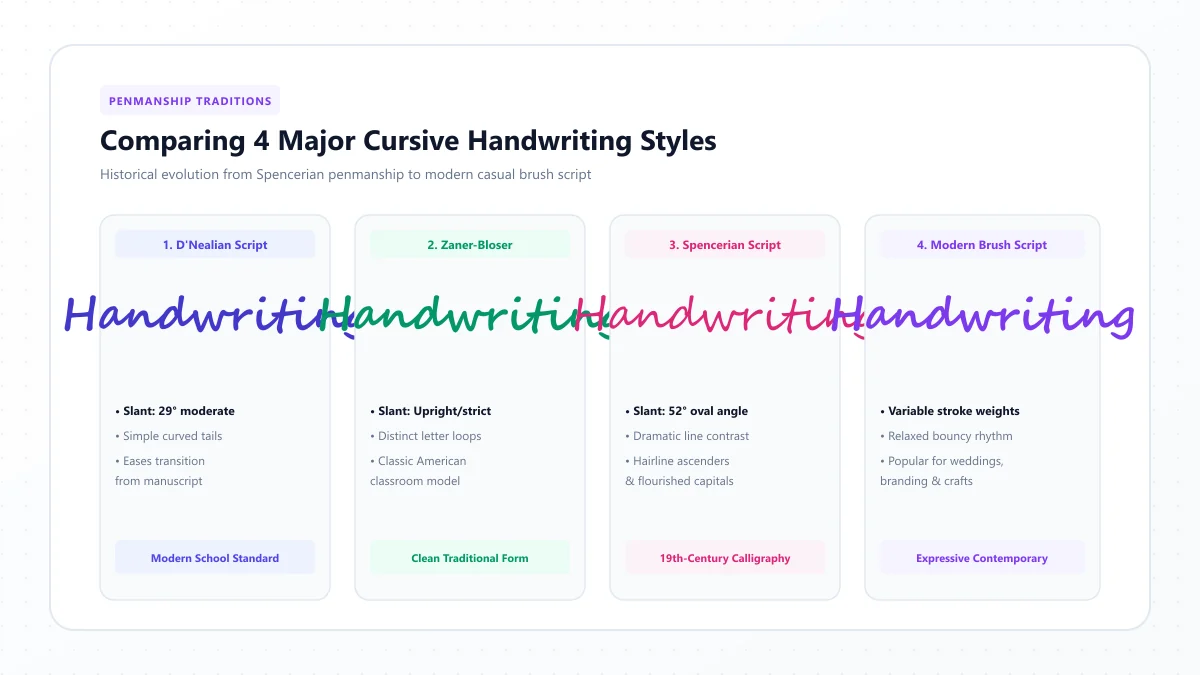
Some people prefer traditional, highly connected cursive, while others use a simpler modern style.
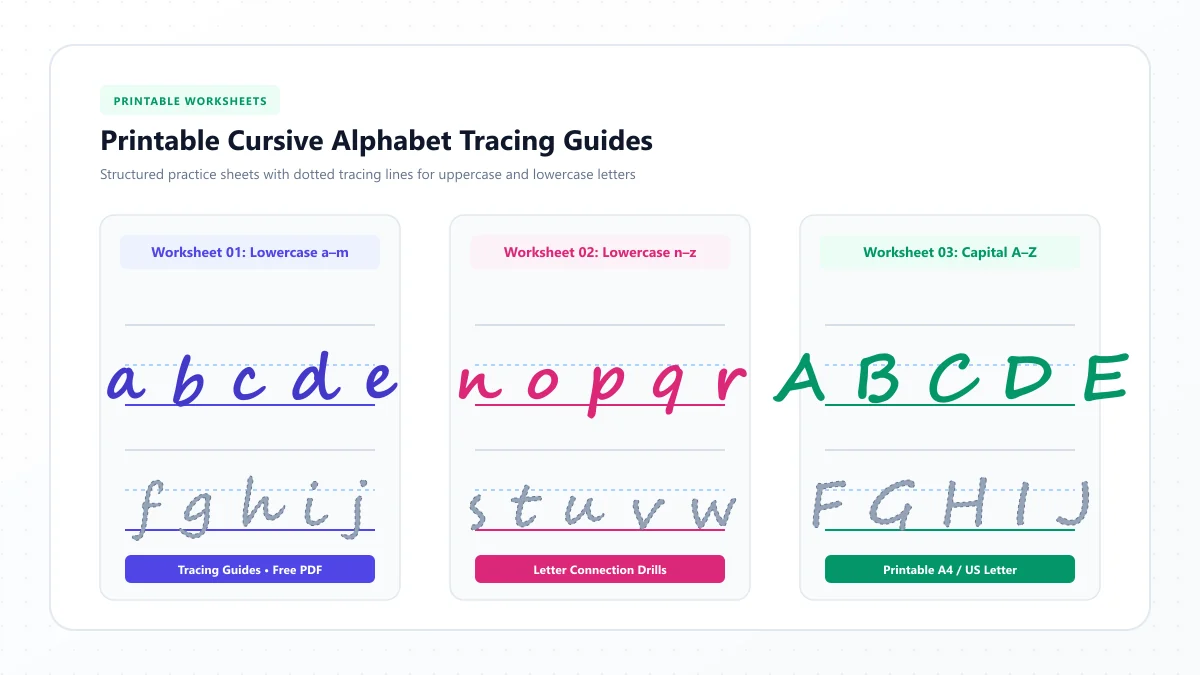
If you're unfamiliar with cursive, our Cursive Alphabet Guide is a useful place to explore the letter shapes.
Where Is Cursive Handwriting Used?
You may encounter cursive in personal letters, journal entries, greeting cards, handwritten notes, and signatures.
It also appears in historical documents, family records, and traditional forms of correspondence.
Although digital communication has changed how we write, cursive remains valuable for people who enjoy handwritten expression or want to read older writing styles.
What Is Print Handwriting?
Print handwriting, also called manuscript handwriting, is a writing style in which letters are generally formed separately.
Unlike cursive, most letters do not connect.
For example, when writing the word "hello" in print, you form each letter individually, usually lifting the pen between letters.
The result resembles the distinct letter shapes commonly seen in children's books and printed educational materials.
Main Characteristics of Print Writing
Print handwriting usually includes:
- Separate letters within words
- Clear spaces between characters
- Familiar uppercase and lowercase forms
- Individual strokes for each letter
- A relatively straightforward visual structure
- Letter shapes similar to common printed typefaces
Print handwriting is often introduced to children early because its letter shapes closely resemble those they see in books and classroom materials.
However, print is not only for beginners.
Many adults continue to use it because they find it clear, practical, and comfortable.
Where Is Print Handwriting Used?
Print is particularly useful for situations where every letter needs to be easy to distinguish.
Common examples include filling out forms, writing labels, taking notes, preparing lists, and recording short instructions.
It is also useful when someone else needs to read your writing quickly.
Cursive vs Print Handwriting: Quick Comparison
Here is a side-by-side comparison of the two styles.
| Feature | Cursive Handwriting | Print Handwriting |
|---|---|---|
| Letter formation | Usually connected | Mostly separate |
| Pen movement | Often continuous | More frequent pen lifts |
| Appearance | Flowing and expressive | Clear and structured |
| Learning process | Requires learning joins | Focuses on individual letters |
| Writing speed | Depends on fluency | Depends on fluency |
| Readability | Depends on familiarity | Often familiar to more readers |
| Common uses | Letters, signatures, journals | Forms, labels, notes |
| Letter shapes | Some differ significantly from print | Resemble printed text |
| Spacing | Joins help guide letter spacing | Spaces must be controlled individually |
| Style variation | Traditional and modern forms | Manuscript and hybrid forms |
Neither style is automatically superior.
A skilled print writer may write faster and more clearly than someone who rarely practices cursive. The reverse can also be true.
The most useful question is not simply which style looks better, but which style helps you communicate comfortably and clearly.
7 Key Differences Between Cursive and Print Handwriting
Although both styles use the same alphabet, their movements and visual characteristics differ in several important ways.
1. Letter Connections
The most noticeable difference is how the letters connect.
In cursive, lowercase letters are usually joined through continuous strokes.
In print, each letter generally stands on its own.
These connections give cursive its distinctive flowing appearance.
Print writing, on the other hand, makes individual letter boundaries easier to recognize.
For beginners, understanding where each letter starts and ends can be particularly helpful.
2. Pen Movement
Cursive emphasizes movement between letters.
Once a writer learns the connecting strokes, the pen can move through much of a word without leaving the page.
Print handwriting usually involves more frequent pen lifts.
However, fewer pen lifts do not automatically mean faster writing.
The complexity of the letter shapes, familiarity with the style, and coordination of hand movements also influence writing speed.
3. Letter Shapes
Some cursive letters look quite different from their printed equivalents.
Lowercase letters such as b, f, r, and s may require extra attention when learning cursive.
Uppercase letters can be even more distinctive.
For example, a traditional cursive capital G may not resemble the printed capital G that beginners recognize.
Print handwriting generally uses shapes closer to the letters found in books and everyday text.
This can make print more immediately familiar.
4. Writing Rhythm
Cursive encourages continuous sequences of movement.
Rather than thinking of every letter as an entirely separate action, a practiced writer may form several letters in one fluid sequence.
Print writing often involves a repeated pattern of forming a letter, lifting the pen, and moving to the next position.
Neither rhythm is necessarily easier for everyone.
Some writers enjoy the continuous movement of cursive, while others feel more comfortable forming separate letters.
5. Readability
Print handwriting is often easier for people who have not learned cursive to read.
Its separate letters resemble familiar printed text.
Cursive requires readers to recognize connected shapes, which can become difficult when the writing is rushed or highly personalized.
However, clear cursive can be very readable, and poorly formed print can be difficult to understand.
Consistent letter shapes, spacing, and size matter more than the style alone.
6. Learning Requirements
Print handwriting typically focuses on forming individual letters.
Cursive requires learning both letter shapes and the movements that connect them.
For beginners, this introduces an additional skill.
However, students who enjoy continuous drawing movements may find some cursive patterns intuitive after guided practice.
Learning experiences vary, and neither writing style should be considered universally easier.
7. Visual Appearance
Cursive often appears traditional, artistic, or personal because of its connected strokes.
Print looks more structured and straightforward.
These impressions can influence where people choose to use each style.
For example, cursive may feel appropriate for a handwritten birthday card, while print may be more practical for an address label.
The best style is the one that fits the message and audience.
Benefits of Cursive Handwriting
Cursive offers several practical advantages, especially for people who enjoy handwriting or want to develop a broader range of writing skills.
1. Encourages Flowing Writing Movements
One appealing characteristic of cursive is its continuous motion.
Once the letter formations become familiar, writers can move smoothly between many letters within a word.
This may make writing feel more natural for some individuals.
However, the actual benefits depend on practice and individual writing habits.
2. Helps You Read Traditional Handwriting
Learning cursive can improve your ability to recognize connected letterforms.
This is particularly useful when reading historical letters, handwritten recipes, family records, or older documents.
Even if you prefer to write in print, being able to recognize cursive can help you understand writing that might otherwise be difficult to decipher.
3. Offers a Personal Writing Style
Cursive leaves room for individual expression.
Some people develop narrow, elegant lettering. Others prefer large loops, rounded letters, or a simpler modern appearance.
Over time, your handwriting can become a recognizable part of your personal communication.
This is one reason cursive remains popular for letters, cards, and journals.
4. Provides Additional Handwriting Practice
Learning cursive introduces new movements and letter patterns.
Practicing these movements can help writers develop coordination and familiarity with different handwriting forms.
Handwriting instruction in general has been associated with improvements in legibility and writing fluency.
However, these findings should not be interpreted as proof that cursive is always better than print.
5. Expands Creative Possibilities
Cursive can make handwritten projects feel distinctive.
It is often used for decorative headings, personal stationery, invitations, and artistic lettering.
If you enjoy typography, exploring different styles can also inspire your own handwriting.
You can experiment with letter shapes using our free Cursive Text Generator.
Keep in mind that digital cursive lettering is not a replacement for practicing handwritten strokes.
Benefits of Print Handwriting
Print handwriting has equally important advantages.
In many situations, it is the more practical choice.
1. Familiar Letter Shapes
Printed letters are similar to the characters children encounter in books, signs, and classroom materials.
This familiarity can help beginners connect written letter shapes with the text they are learning to recognize.
It also makes print useful when writing for people who may not know cursive.
2. Clear Individual Letters
Separating letters can make words easier to interpret.
This is valuable for forms, labels, instructions, and other situations where accuracy is important.
For example, a printed name on an application form may be easier to read than a highly stylized cursive signature.
3. Straightforward Early Practice
Print instruction commonly begins with basic strokes, curves, circles, and straight lines.
Learners can focus on forming each letter before adding the complexity of connections.
This provides a structured approach to early handwriting practice.
4. Useful for Everyday Tasks
Print handwriting fits naturally into everyday activities.
Writing a grocery list, labeling a storage box, or leaving short instructions rarely requires decorative lettering.
Clear print can communicate information efficiently.
5. Easy to Combine With Other Styles
Many people develop a hybrid writing style as they grow older.
They may print certain letters while connecting others.
This flexibility allows writers to create a style that feels comfortable and remains legible.
You do not have to choose one method exclusively.
Is Cursive Faster Than Print Handwriting?
One of the most common claims about cursive is that it is faster because the writer lifts the pen less often.
There is some logic behind this idea.
When letters connect smoothly, fewer interruptions may be needed between strokes.
However, research does not consistently show that cursive is faster than print for every writer.
What Does Research Say?
In a study involving 600 students in Grades 4 through 9, researchers Steve Graham, Naomi Weintraub, and Virginia Berninger examined handwriting style, speed, and legibility.
The study found that students using mixed handwriting styles were faster than those who used only manuscript or only cursive writing.
Interestingly, mixed writing that was predominantly cursive generally received higher legibility ratings than the other styles examined.
This suggests that combining letterforms can be effective for some writers.
It does not mean everyone should adopt the same hybrid style.
You can explore the research through The Relationship Between Handwriting Style and Speed and Legibility.
Why Writing Speed Varies
Several factors influence how quickly someone writes:
- Familiarity with letter shapes
- Consistency of practice
- Hand coordination
- Writing comfort
- Letter size
- Required accuracy
- The complexity of the words being written
A person who has practiced print handwriting for years may write much faster in print than in unfamiliar cursive.
Likewise, someone comfortable with cursive may prefer its continuous rhythm.
The takeaway: Practice and fluency are more reliable priorities than assuming one style is always faster.
Is Cursive or Print Easier to Read?
For many readers, clear print handwriting is easier to recognize because the letters resemble familiar printed text.
However, readability depends on more than whether letters connect.
A neat cursive sentence can be easier to read than a rushed printed sentence.
Consider these factors.
Letter Consistency
Consistent letter shapes make handwriting easier to understand.
If the same letter changes dramatically throughout a paragraph, the reader has to work harder.
Spacing
Clear spaces between words are essential in both styles.
Cursive writers must avoid connecting separate words, while print writers need to maintain enough separation between individual letters and words.
Size
Very small handwriting can be difficult to read.
Keeping letters at a comfortable size improves clarity.
Familiarity
Someone who regularly reads cursive may recognize connected words quickly.
A reader who has never learned cursive may struggle with the same text.
This is one reason print remains useful for information intended for a broad audience.
Is Cursive Handwriting Better for the Brain?
You may have heard claims that cursive improves memory, makes children more intelligent, or produces better academic results.
These statements need careful interpretation.
Research supports the value of handwriting instruction, but not every handwriting benefit is unique to cursive.
A comprehensive meta-analysis published in Educational Psychology Review found that handwriting instruction improved handwriting legibility and fluency compared with control conditions.
The analysis also reported improvements in certain measures of students' writing performance.
However, those findings concerned handwriting instruction more broadly.
They do not establish that cursive is universally superior to print.
A separate study on cursive instruction involving 141 first-grade students reported encouraging results for a specific teaching approach, but such findings should be considered within the context of the study's methods and participants.
What Does This Mean for Learners?
Both cursive and print require attention to letter formation, movement, and written language.
Practicing either can contribute to handwriting development.
Rather than assuming cursive automatically improves intelligence or memory, focus on developing a comfortable, legible, and fluent writing style.
Consistent practice matters.
Which Is Better for Children: Cursive or Print?
For children beginning to write, print handwriting is often introduced first.
Its separate letters resemble the characters they see in books and educational materials.
This can make early letter recognition and formation more straightforward.
Once children become comfortable forming letters, they may be introduced to cursive.
However, teaching approaches differ across countries, schools, and educational programs.
Some systems introduce joined writing earlier than others.
Why Print Is Commonly Taught First
Print allows beginners to work on one letter at a time.
They can practice:
- Recognizing uppercase and lowercase letters
- Following stroke directions
- Maintaining letter size
- Writing simple words
- Keeping appropriate spacing
These foundational skills are useful regardless of which handwriting style a child eventually prefers.
When Should Children Learn Cursive?
There is no universal age that works for every child.
A reasonable time to introduce cursive is when the learner has sufficient control over basic writing movements and can benefit from learning connected strokes.
Teachers and parents should consider the child's development, interest, and educational requirements.
For beginners, short practice sessions are often more productive than long, tiring exercises.
Our guide on How to Teach Cursive Writing to Kids offers additional learning ideas.
Is Cursive Harder to Learn Than Print?
Cursive can initially feel more challenging because it involves unfamiliar letter shapes and connecting movements.
For example, a beginner may know how to print the lowercase letters r, s, and f but find their cursive equivalents confusing.
Learning the connections between letters adds another step.
However, difficulty often decreases with guided repetition.
Students who enjoy drawing smooth lines, curves, and loops may find certain cursive movements enjoyable.
Common Challenges When Learning Cursive
Beginners may struggle with:
- Remembering unfamiliar letter shapes
- Joining letters smoothly
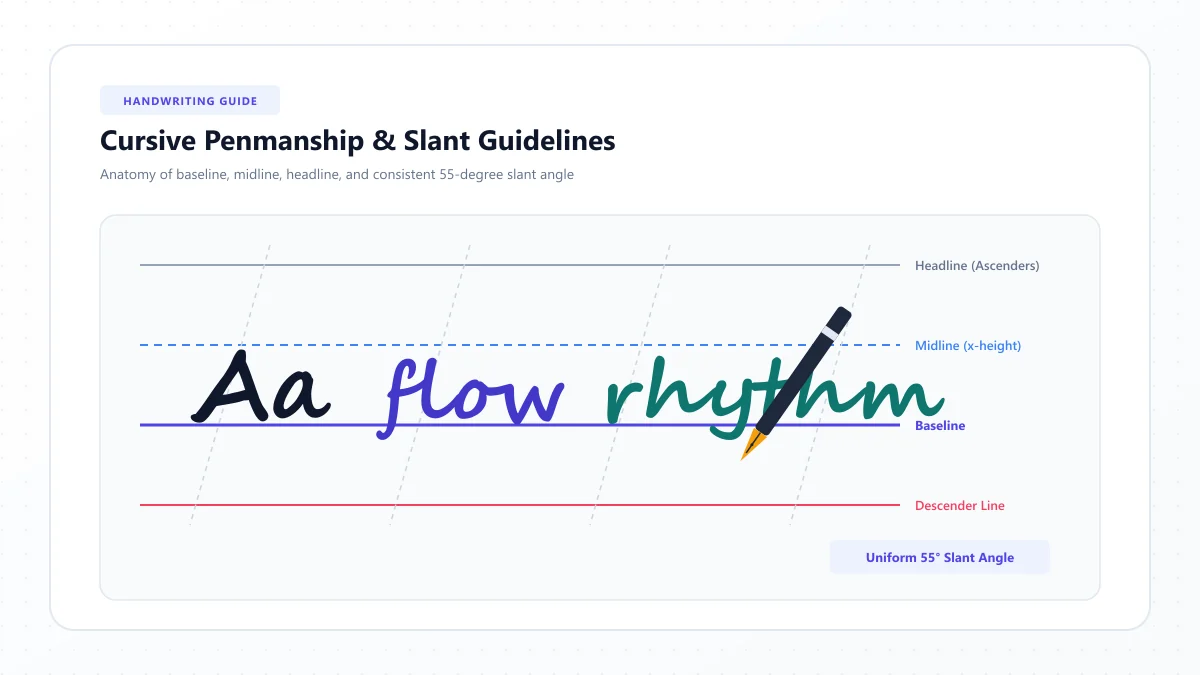
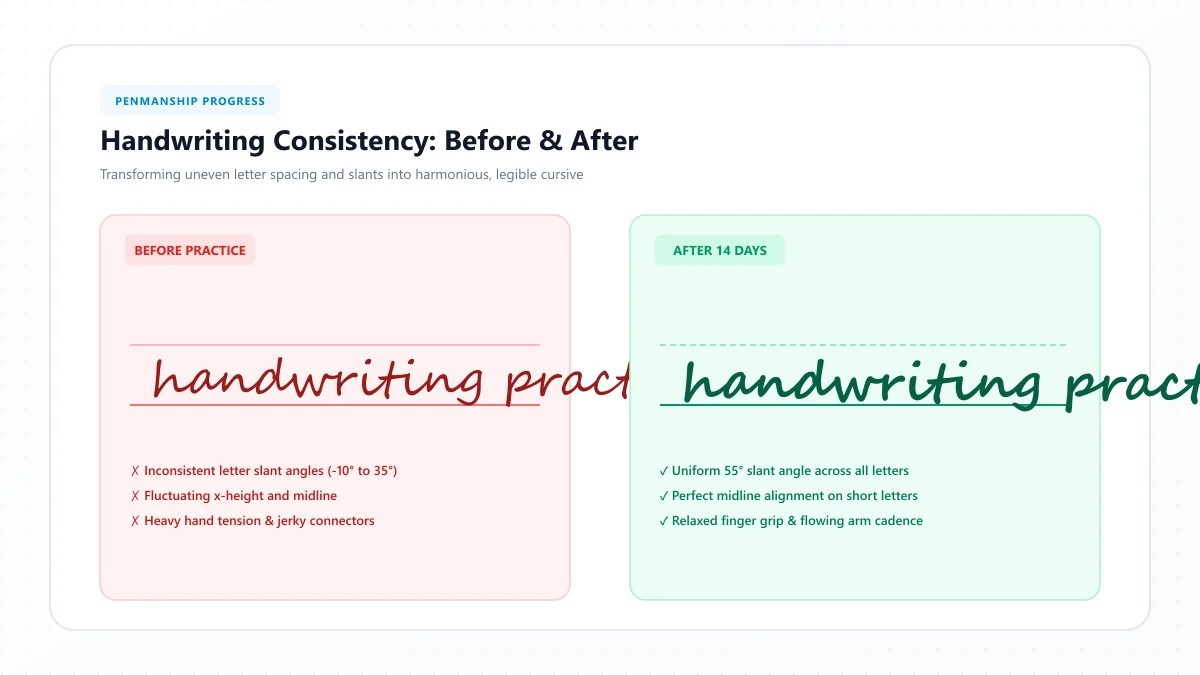
- Maintaining a consistent slant
- Controlling loops and curves
- Keeping word spacing clear
- Writing without excessive hand pressure
These challenges can be addressed through gradual practice.
Start with simple strokes, then progress to letters, short words, and complete sentences.
For step-by-step guidance, explore How to Write in Cursive.
How to Learn Cursive Handwriting Step by Step
If you already know how to print and want to learn cursive, start with the basics.
You do not need expensive equipment.
A comfortable pen or pencil, lined paper, and a little patience are enough.
Step 1: Practice Basic Strokes
Before writing full letters, practice simple shapes.
Focus on:
- Upward strokes
- Downward strokes
- Small loops
- Rounded curves
- Connecting lines
These movements form the foundation of many cursive letters.
Step 2: Learn Lowercase Letters
Start with lowercase letters because they appear frequently in ordinary words.
Some learning programs group letters according to similar movements.
For example, you might practice i, u, and t together before progressing to more complex shapes.
Focus on smooth, controlled strokes rather than speed.
Step 3: Practice Letter Connections
Once you can form individual letters, begin joining them.
Try short combinations such as:
- in
- it
- up
- on
- all
Pay attention to how one letter leads into the next.
Our guide on How to Connect Cursive Letters explains the process in more detail.
Step 4: Write Short Words
Choose familiar words that are easy to recognize.
For example:
- love
- dream
- happy
- smile
- family
Write each word slowly and check the connections.
Repeating a small number of words can help you become familiar with common letter combinations.
Step 5: Practice Complete Sentences
Once individual words feel comfortable, try short sentences.
For example:
Today is a beautiful day.
Practice makes progress.
Every small step matters.
These sentences help you work on spacing and writing rhythm.
Step 6: Develop Your Own Style
As your cursive improves, you may naturally develop preferences for certain letter shapes or connections.
This is normal.
The goal is not to copy someone else's handwriting perfectly.
Aim for a consistent style that is comfortable and easy to read.
How to Improve Print Handwriting
You don't have to switch to cursive to improve your handwriting.
Print can become clearer and more attractive with regular practice.
Here are a few simple ways to improve it.
Focus on Consistent Letter Size
Try to keep lowercase letters at a similar height.
Use lined paper if you have trouble maintaining consistent proportions.
Improve Word Spacing
Leave a clear gap between words.
Avoid squeezing letters together or spreading them too far apart.
Slow Down When Practicing
Writing quickly can reinforce inconsistent letter shapes.
Practice slowly at first, then gradually increase your pace as the movements become comfortable.
Check Your Grip and Posture
Hold your pen comfortably without excessive pressure.
Sit in a position that allows your writing hand to move freely.
If writing causes pain, stop and adjust your technique rather than forcing yourself to continue.
Use Short Practice Sessions
A few focused minutes can be more useful than a long session completed while tired.
Choose a sentence, write it several times, and compare your results.
Look for improvements in spacing, letter shape, and consistency.
Can You Combine Cursive and Print Handwriting?
Absolutely.
Many adults naturally write using a combination of both styles.
For example, you might print most letters while connecting certain lowercase combinations.
This is sometimes called hybrid or mixed handwriting.
It allows you to use movements that feel comfortable without strictly following every rule of traditional cursive.
Why People Develop Mixed Handwriting
As writers become more experienced, they often adapt letterforms to suit their needs.
A fully connected cursive style may feel natural for some words, while printing individual letters may make other words clearer.
Over time, these choices can become automatic.
A mixed style is not necessarily incorrect or careless.
If the writing is clear and comfortable, it can be a practical everyday approach.
Cursive vs Print for Note-Taking
When taking notes, the goal is usually to record information quickly enough that you can understand it later.
Some people prefer cursive because they enjoy continuous writing movements.
Others prefer print because the separate letters remain clear when writing rapidly.
A hybrid style may also work well.
What Matters Most?
Instead of focusing only on the writing style, consider:
- Can you read your notes afterward?
- Can you write without excessive hand strain?
- Can you keep up with the information?
- Are headings and important details easy to identify?
- Does the handwriting support your learning process?
For studying, consistency and organization can be more useful than choosing a particular handwriting style.
Try taking notes in both cursive and print, then compare which version is easier for you to review.
Cursive vs Print for Signatures
Signatures are commonly associated with flowing handwriting, but they do not have to be written entirely in cursive.
Some people sign their names using connected letters.
Others use a combination of printed initials and cursive strokes.
What matters for practical signing is that the signature works for the context in which it is used.
For everyday personal documents, you may prefer a style you can reproduce consistently.
If you're experimenting with a signature design, our Cursive Signature Generator can provide visual inspiration.
Keep in mind that decorative digital lettering is not automatically a legally valid electronic signature.
Formal signing requirements depend on the document and applicable laws.
Which Handwriting Style Should You Choose?
The best choice depends on what you want to accomplish.
Choose Cursive If You Want To:
- Learn traditional connected handwriting
- Read handwritten letters and historical documents
- Develop a personal penmanship style
- Create decorative handwritten notes
- Explore calligraphy-inspired writing
- Practice smooth, continuous letter movements
Choose Print If You Want To:
- Write clearly on forms and labels
- Use familiar letter shapes
- Make instructions easy for others to read
- Practice basic handwriting skills
- Create straightforward notes and lists
- Prioritize clarity over decoration
Choose a Mixed Style If You Want To:
- Combine the movements you find comfortable
- Maintain readability without following strict style rules
- Adapt your handwriting to different tasks
- Develop a natural everyday writing rhythm
There is no need to treat cursive and print as opposing skills.
Learning both gives you more flexibility.
Frequently Asked Questions
What is the main difference between cursive and print handwriting?
Cursive handwriting generally connects letters using flowing strokes, while print handwriting forms most letters separately. Cursive often has a more decorative appearance, whereas print tends to resemble the individual letter shapes found in books.
Is cursive handwriting faster than print?
Not necessarily. Although cursive often involves fewer pen lifts, research has not consistently established that it is faster for everyone. Writing speed depends on practice, fluency, coordination, and individual writing habits.
Is cursive easier to learn than print?
Print is often easier for beginners because its letters resemble familiar printed text. Cursive introduces additional movements and connections. However, learning experiences vary between individuals.
Is cursive better for the brain than print?
Research supports the benefits of handwriting instruction, but there is not enough evidence to conclude that cursive is universally better for cognitive development than print. Both styles involve letter formation, coordination, and practice.
Why do schools teach print before cursive?
Many schools introduce print first because its separate letter shapes resemble those children encounter in books. Once learners develop basic handwriting control, they may be introduced to connected cursive writing.
Is print handwriting more readable than cursive?
Print is often more familiar to readers, particularly those who have not learned cursive. However, legibility depends on letter formation, spacing, size, and the individual writer's skill.
Can adults learn cursive handwriting?
Yes. Adults can learn cursive through gradual practice, beginning with basic strokes and lowercase letters before progressing to connected words and sentences.
Is it okay to mix cursive and print writing?
Yes. Mixed handwriting is common and can be practical. Many people naturally combine connected and separate letterforms to create a comfortable everyday style.
Do signatures have to be written in cursive?
No. Signatures do not always have to use traditional cursive lettering. Requirements depend on the context, and a consistent personal signing style may include connected letters, printed letters, or a combination.
Should I teach my child cursive or print first?
Many educational programs begin with print handwriting because of its familiar letter shapes. The appropriate approach depends on the child's development, educational requirements, and the teaching method being used.
Final Thoughts
The debate between cursive and print handwriting doesn't have to end with one winner.
Both styles are useful, and both can become attractive and efficient with practice.
Cursive offers flowing connections, expressive letterforms, and the ability to read traditional handwritten material.
Print provides familiar shapes, clear letter separation, and a practical approach to everyday writing.
Research also reminds us that handwriting skill develops through instruction and experience, not simply through choosing one style over another.
If you're a beginner, start with whichever method helps you write clearly and comfortably.
If you already know print, learning cursive can be a rewarding way to expand your handwriting skills.
And if you naturally combine the two, there's nothing wrong with developing a style that works for you.
Want to explore beautiful cursive letterforms before practicing them on paper? Visit our free Cursive Text Generator and discover different decorative lettering styles for names, headings, and creative inspiration.